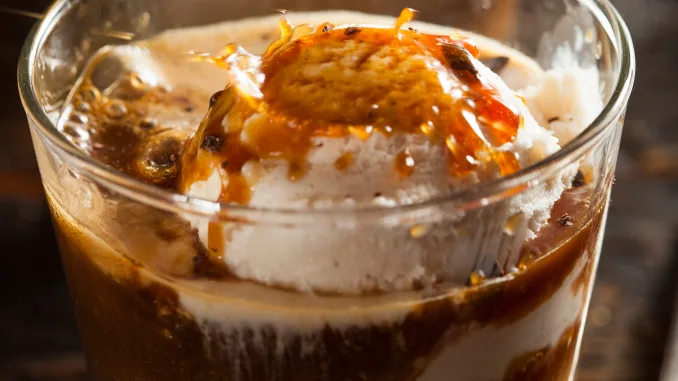
Few desserts demonstrate the elegance of Italian culinary minimalism as effectively as the affogato. At its core, it consists of only two components: hot espresso and cold gelato. Yet the interplay of temperature, bitterness, sweetness, fat, and aromatics creates a dessert whose complexity far exceeds its ingredient list. The name derives from the Italian verb affogare, meaning “to drown.” In literal terms, the gelato is drowned in espresso. In experiential terms, the palate is immersed in contrast.
Affogato occupies an ambiguous space between beverage and dessert. In Italian cafés, it is typically listed under desserts rather than coffee drinks, though its structure resembles a composed beverage. It is served in a small glass or cup, usually after a meal, bridging the ritual of espresso service with the indulgence of gelato. Unlike heavily constructed plated desserts, affogato emphasizes immediacy: the espresso must be poured at the moment of service to preserve the thermal shock that defines the dish.
History
Affogato emerged in Italy during the twentieth century, most likely in the post–World War II era when espresso technology and gelato culture both reached widespread popularity. The development of modern lever espresso machines in the early 1900s—and their refinement in mid-century Italy—made concentrated, crema-topped coffee readily available in cafés across the country. Simultaneously, gelaterias flourished, offering artisanal frozen desserts made with fresh milk, eggs, and regional flavorings.
The pairing of espresso and gelato likely evolved organically within this café ecosystem. Italian culinary traditions frequently emphasize simple assemblies of high-quality ingredients rather than elaborate constructions. The affogato reflects this ethos. It requires no baking, no elaborate garnish, and no mise en place beyond two well-prepared components. Its conceptual lineage aligns with other Italian combinations that exploit hot-cold contrast, such as zabaglione poured over chilled fruit.
By the late twentieth century, affogato began appearing outside Italy, particularly in specialty coffee shops in North America and Australia. As third-wave coffee culture expanded, so too did reinterpretations of the affogato. Baristas experimented with different roast profiles, single-origin espressos, alternative milks, and flavored syrups. Pastry chefs incorporated liqueurs, shaved chocolate, crushed amaretti biscuits, toasted nuts, and caramel sauces. Despite these variations, the defining principle remains unchanged: a scoop of frozen dairy overtaken by freshly extracted espresso.
Structural and Sensory Analysis
Affogato’s success lies in contrast and emulsification. When hot espresso contacts frozen gelato, several processes occur simultaneously. The outer layer of gelato melts rapidly, forming a creamy interface that blends with the coffee. Fat from the gelato emulsifies with the espresso’s dissolved solids and oils, softening bitterness while enhancing body. The crema integrates into the melting ice cream, contributing a velvety mouthfeel.
Vanilla gelato is the canonical choice because its relatively neutral sweetness allows the espresso’s aromatics—caramelized sugars, toasted nuts, cocoa, and subtle acidity—to remain perceptible. The dessert’s balance depends on proportion. Too much espresso overwhelms the gelato, producing a diluted coffee soup. Too little espresso results in insufficient melting and an overly sweet, static spoonful. A common ratio is one standard scoop (approximately 80–100 grams) of gelato to one shot (25–30 milliliters) of espresso.
Temperature is equally critical. The gelato should be firm but not rock hard; ideally, it rests briefly at room temperature before service to achieve a scoopable consistency. The espresso should be freshly extracted, ideally between 90–96°C at brew temperature, delivered immediately to preserve volatile aromatics. The drama of affogato lies in this temporal moment: the pour, the rapid melting, the shifting textures over the first few minutes.
Preparation Fundamentals
At its simplest, preparing affogato requires:
-
High-quality vanilla gelato (or premium vanilla ice cream if gelato is unavailable).
-
Freshly brewed espresso.
-
A pre-chilled serving glass.
The glass is often slightly chilled to prolong the melting process without freezing the gelato’s surface excessively. The scoop is placed in the vessel first. Espresso is poured directly over the top at the table or counter. Some establishments serve the espresso separately in a small pitcher to allow the guest to control the pour.
Optional additions may include a splash of liqueur such as amaretto or Frangelico, shaved dark chocolate, cocoa nibs, or crushed biscotti. These additions should be used sparingly; the dish depends on clarity rather than accumulation.
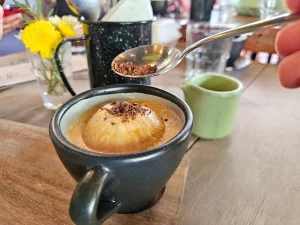
Salted Caramel Affogato
The salted caramel variation builds on affogato’s inherent affinity for caramelized notes. Espresso naturally contains flavor compounds produced during Maillard reactions and caramelization in roasting. Introducing salted caramel amplifies these tones while adding controlled salinity to heighten sweetness and suppress bitterness.
Salt in desserts functions as a flavor potentiator. At low concentrations, sodium ions reduce perceived bitterness and intensify sweet and aromatic notes. In the context of affogato, a restrained use of flaky sea salt can sharpen the dessert’s structure, preventing cloying sweetness from caramel sauce while accentuating espresso’s depth.
The salted caramel affogato can be constructed in two ways: by incorporating salted caramel directly into the ice cream base, or by layering caramel sauce over vanilla gelato before pouring the espresso. The latter method offers greater textural contrast and clearer flavor delineation.
Salted Caramel Affogato Recipe
Yield: Serves 2
Components
-
2 generous scoops high-quality vanilla gelato (or salted caramel ice cream if preferred)
-
2 shots freshly extracted espresso
-
4 tablespoons homemade salted caramel sauce (recipe below)
-
Flaky sea salt (such as Maldon), a small pinch per serving
Homemade Salted Caramel Sauce
Ingredients
-
200 grams granulated sugar
-
60 milliliters water
-
120 milliliters heavy cream (room temperature)
-
40 grams unsalted butter (room temperature, cubed)
-
½ teaspoon fine sea salt (adjust to taste)
Method
In a heavy-bottomed saucepan, combine sugar and water. Heat over medium without stirring; agitation may induce crystallization. Instead, gently swirl the pan to distribute heat evenly. As the mixture approaches 170–175°C, it will transition from clear to pale amber, then to deep copper. Monitor closely: caramel can burn rapidly beyond 180°C.
When the desired amber colour develops—indicating complex caramelization but before acrid notes emerge—remove the pan from heat. Carefully add the heavy cream in a slow stream. The mixture will bubble vigorously due to rapid steam expansion; this is normal. Whisk continuously until smooth. Add butter and whisk until emulsified. Stir in fine sea salt.
Allow the caramel to cool slightly; it should be thick but pourable. If prepared in advance, rewarm gently to restore fluidity before use.
Assembly
Place serving glasses in the freezer for approximately 5 minutes. This step is optional but extends textural contrast.
Spoon two tablespoons of salted caramel sauce into the base of each glass. Add a scoop of vanilla gelato on top. Drizzle an additional tablespoon of caramel over the crown of each scoop, allowing it to cascade down the sides.
Extract espresso immediately before service. Use freshly ground coffee, ideally a medium to medium-dark roast with chocolate and nut notes rather than pronounced acidity. Each shot should yield roughly 30 milliliters in 25–30 seconds of extraction.
Pour one shot of espresso directly over each prepared scoop. The espresso should strike the apex of the gelato, creating rivulets that melt channels through caramel and ice cream. Finish with a minimal pinch of flaky sea salt over the top. Serve immediately with a spoon.
Technical Considerations
The salted caramel affogato introduces additional variables. Caramel viscosity affects melt dynamics. If the sauce is too thick, it resists integration with espresso and gelato, forming sticky layers. If too thin, it dissolves instantly, reducing textural interest. The ideal viscosity allows partial suspension within the melting gelato, forming streaks rather than complete homogenization.
Roast profile matters significantly. A highly acidic, light-roast espresso may clash with caramel sweetness. Conversely, an excessively dark roast may produce harsh bitterness. A balanced roast with notes of cocoa, toasted hazelnut, and brown sugar complements caramel’s profile.
Salt dosage must remain precise. Excess salt overwhelms and introduces brininess. A few flakes suffice. The goal is contrast, not salinity dominance.
Sensory Experience
Upon the first spoonful, the diner encounters hot espresso pooling at the base, softened by melted vanilla cream. Threads of salted caramel weave through the mixture, adding buttery depth and slight chewiness where caramel thickens against cooler gelato. The salt sharpens perception, momentarily amplifying sweetness before allowing espresso bitterness to reassert itself in a controlled, rounded manner.
As minutes pass, the affogato evolves. Early bites emphasize contrast; later ones resemble a sweetened coffee custard. This temporal progression is intrinsic to the dessert. It is meant to be eaten slowly but not delayed.
Variations and Enhancements
Although restraint defines the affogato tradition, minor enhancements can be incorporated without obscuring its character. Finely chopped toasted pecans may reinforce caramel’s nutty notes. A small splash of bourbon in the caramel sauce introduces vanillin and oak undertones. Dark chocolate shavings add bitterness and texture.
For a more structured presentation, caramel can be brushed along the inside walls of the glass before adding gelato, creating visual contrast. However, visual flourish should not compromise temperature management.
Cultural and Culinary Significance
Affogato endures because it distills multiple culinary principles into a minimal form: contrast, balance, immediacy, and ingredient integrity. It represents a synthesis of Italy’s dual obsessions—espresso craftsmanship and gelato artistry—without embellishment. In contemporary contexts, it also symbolizes the convergence of specialty coffee culture and dessert innovation.
The salted caramel version reflects global culinary exchange. Caramel, though present in European pastry traditions for centuries, became especially prominent in modern Anglo-American dessert culture. Its integration into affogato demonstrates how a classical template can absorb new flavor languages without losing structural coherence.
In professional kitchens, affogato offers operational efficiency. It requires no baking during service, minimal plating time, and high perceived sophistication relative to labor input. In domestic settings, it provides an elegant finale to dinner with limited preparation overhead.
Affogato, in its original or salted caramel form, exemplifies culinary economy. Two primary components, properly executed, create a dessert that feels both immediate and contemplative. It demands attention to detail—temperature, extraction, seasoning—but rewards that attention with layered sensory complexity. When espresso floods frozen cream and caramel glistens under a scatter of salt, the result is neither merely coffee nor merely ice cream. It is an orchestrated collision of heat and cold, bitter and sweet, fluid and solid. In that collision lies its enduring appeal.


Leave a Reply