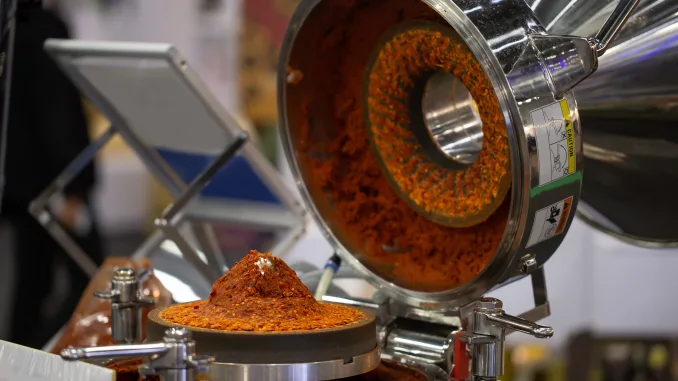
Grinding is a fundamental process in the food industry, used to reduce the size of solid food particles to achieve a desired texture, consistency, or functional property. The process begins with the selection of the appropriate grinding equipment based on the physical and chemical characteristics of the raw material, such as hardness, moisture content, fibrousness, and fat content. Hard, dry materials like grains or spices require impact or compression-based grinders, while soft or moist foods like fruits, vegetables, and meats are better processed using cutting or shearing mechanisms.
During grinding, mechanical energy is applied to the food material, breaking down its structure through one or more mechanisms such as impact, compression, shearing, or attrition. Impact grinding, as in hammer or pin mills, relies on high-speed collisions of the material with hammers, pins, or other surfaces, resulting in particle fragmentation. Compression-based grinding, common in roller or disc mills, crushes the food between two surfaces to achieve size reduction, while knife or cutter mills use shearing and cutting forces to slice soft or fibrous materials.
The grinding process can be conducted either in a dry or wet environment. Dry grinding is suitable for foods with low moisture content, producing powders that can be easily stored or further processed, while wet grinding is used for high-moisture foods, creating pastes, purees, or emulsions. In specialized cases, cryogenic grinding is employed, where the material is frozen, usually with liquid nitrogen, to prevent heat generation and preserve volatile compounds, flavors, and nutritional content during size reduction.
As the material passes through the grinder, screens, sieves, or classifiers are often used to control particle size and ensure uniformity. Continuous grinding systems in industrial settings are designed for high throughput, allowing the material to move steadily through the grinding chamber while maintaining consistent quality and particle distribution. Heat generation, dust formation, and contamination are critical considerations in the process, necessitating careful design of cooling, ventilation, and cleaning systems to maintain product integrity and food safety standards.
Ultimately, grinding transforms raw ingredients into forms that are easier to handle, process, and consume. It enables flour from grains, powders from spices, pastes from nuts, and smooth textures in sauces, playing an essential role in shaping the functional and sensory qualities of food products. The process requires a balance between efficiency, energy consumption, and the preservation of flavor, nutrition, and quality, making it a highly controlled and vital operation in the modern food industry.
Mathematical Models For Grinding
Methods Of Grinding
1. Hammer Mills
-
Principle: High-speed rotating hammers impact the food material, breaking it into smaller particles.
-
Applications: Grains (wheat, corn), spices, sugar, and feed processing.
-
Advantages:
-
High throughput
-
Can handle fibrous materials
-
Adjustable particle size via screens
-
-
Limitations:
-
Can generate heat, affecting heat-sensitive foods
-
Noise and dust generation
-
2. Roller Mills / Pin Mills
-
Principle: Food is crushed between rotating or stationary rollers (roller mill) or impacted by pins (pin mill) to reduce particle size.
-
Applications:
-
Sugar refining
-
Cocoa powder
-
Starch and flour milling
-
-
Advantages:
-
Consistent particle size
-
Lower heat generation than hammer mills
-
-
Limitations:
-
Less suitable for very hard materials
-
3. Knife Mills / Cutter Mills
-
Principle: Rotating knives cut the food into smaller pieces. Often combined with screens for uniformity.
-
Applications:
-
Vegetables and herbs
-
Meat and fish processing
-
Freeze-dried foods
-
-
Advantages:
-
Gentle on fibrous and soft foods
-
Suitable for moist materials
-
-
Limitations:
-
Not ideal for extremely hard or dry materials
-
4. Ball Mills / Media Mills
-
Principle: Food material is crushed by grinding media (balls or beads) in a rotating drum or chamber.
-
Applications:
-
Chocolate and cocoa mass
-
Peanut butter and nut pastes
-
Sauces and purees
-
-
Advantages:
-
Fine, uniform grinding
-
Can produce pastes or slurries
-
-
Limitations:
-
Lower throughput
-
Higher energy consumption
-
5. Jet Mills (Air or Fluidized Bed Mills)
-
Principle: High-velocity air or steam accelerates food particles, which collide and fracture.
-
Applications:
-
Spices
-
Coffee
-
Pharmaceutical-grade food powders
-
-
Advantages:
-
No moving parts contact the product (reduces contamination)
-
Produces ultrafine powders
-
-
Limitations:
-
High energy use
-
Less suitable for moist or sticky foods
-
6. Cryogenic Grinding
-
Principle: Food is frozen (usually with liquid nitrogen) and then ground using hammer, pin, or ball mills.
-
Applications:
-
Herbs and spices
-
Heat-sensitive or oily foods
-
Chocolate, nuts
-
-
Advantages:
-
Prevents heat-induced flavor loss
-
Produces very fine, dry powders
-
-
Limitations:
-
High operational cost
-
Requires specialized equipment
-
7. Wet Mills / Colloid Mills
-
Principle: Food is ground in the presence of a liquid to produce fine suspensions or emulsions.
-
Applications:
-
Peanut butter
-
Mayonnaise and sauces
-
Fruit and vegetable purees
-
-
Advantages:
-
Produces smooth textures
-
Can handle high-moisture foods
-
-
Limitations:
-
Requires liquid handling
-
Cleaning can be complex
-
8. Roller-Disc and Disc Mills
-
Principle: Material is pressed or sheared between two discs, often with one rotating.
-
Applications:
-
Grain and starch milling
-
Sugar and cocoa
-
Dry herbs and spices
-
-
Advantages:
-
High efficiency
-
Uniform particle size
-
-
Limitations:
-
Not ideal for sticky or moist materials
-
Key Selection Criteria in the Food Industry
-
Food properties: Hardness, moisture content, oil/fat content, fibrousness.
-
Desired particle size: Coarse, fine, or ultrafine powder.
-
Throughput requirement: Batch vs continuous production.
-
Heat sensitivity: Some grinders generate heat, which can alter flavor or nutrition.
-
Hygiene and cleanability: Food-grade materials and CIP (Clean-In-Place) compatibility.


Leave a Reply