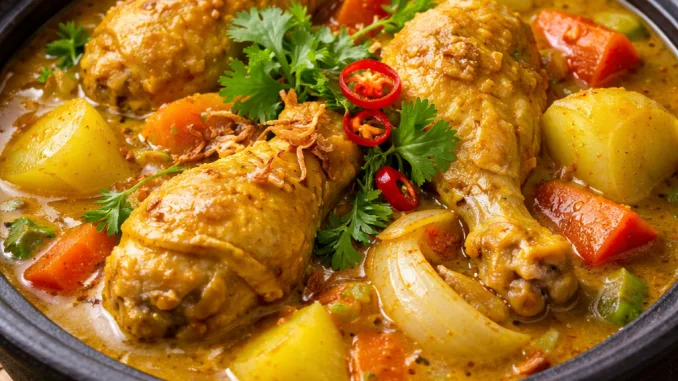
Vietnamese Chicken Curry, known as Cà Ri Gà, is a rich, aromatic, and comforting dish that exemplifies the Vietnamese culinary tradition of blending local ingredients with global influences. Infused with coconut milk, lemongrass, and a unique Vietnamese curry powder, this dish represents the country’s adaptation of Indian and Southeast Asian spice profiles to create something distinct and deeply satisfying. Often served with rice, noodles, or crusty bread, cà ri gà is a versatile meal, equally at home in a family dinner or at a festive gathering.
Historical and Cultural Origins
Vietnamese curry has its roots in cultural fusion. Although curries are not native to Vietnam in the traditional sense, their presence can be traced back to historical contact with Indian traders, French colonialism, and neighboring Southeast Asian countries like Cambodia and Thailand.
The word cà ri is a direct loan from the Tamil word “kari,” meaning sauce. Vietnamese curry is believed to have evolved from Indian and Cham influences, particularly in Central and Southern Vietnam, where the Cham people, with their Hindu traditions, introduced aromatic curries centuries ago. Over time, Vietnamese cooks adapted the Indian-style curry, lightening the spice load, adjusting the texture, and incorporating ingredients like lemongrass, fish sauce, and sweet potatoes.
French colonization also played a role in shaping modern Vietnamese cuisine. The inclusion of baguette (bánh mì) as a serving option for cà ri gà is a clear example of this influence.
Flavours and Ingredients
Vietnamese Chicken Curry balances bold flavors with a gentle touch. Unlike Indian curries, which often rely on intense spice blends and longer cooking times, cà ri gà is lighter, slightly sweet, and fragrant with herbs. Its main ingredients typically include:
1. Chicken
Bone-in chicken thighs or drumsticks are preferred for their tenderness and ability to absorb flavor. The chicken is often marinated in curry powder and fish sauce before cooking.
2. Curry Powder
The cornerstone of the dish is a special Vietnamese-style curry powder, often a local blend that includes turmeric, coriander, cumin, star anise, chili, and cinnamon. The spice mix gives cà ri gà its golden hue and gentle warmth.
3. Aromatics
Lemongrass, garlic, shallots, and sometimes ginger are sautéed at the beginning to form a flavorful base. Lemongrass, in particular, gives the dish a uniquely Southeast Asian character.
4. Coconut Milk
Creamy and mildly sweet, coconut milk tempers the spices and adds a luscious texture. It’s used alongside chicken stock or water to form the curry broth.
5. Vegetables
The most common vegetables in cà ri gà are potatoes, carrots, and sweet potatoes. These absorb the curry flavors and contribute a hearty texture. In Southern versions, taro may also be included.
6. Fish Sauce and Sugar
Fish sauce provides umami depth, while a touch of sugar rounds out the flavor. Vietnamese cuisine often uses sugar subtly to balance salty or spicy elements.
Preparation Method
Though variations exist, the basic method of making cà ri gà follows these steps:
-
Marinate the Chicken: Chicken pieces are typically marinated for at least 30 minutes in curry powder, fish sauce, garlic, and sometimes lemongrass. This helps the spices penetrate the meat.
-
Sauté the Aromatics: Shallots, garlic, and lemongrass are sautéed until fragrant. The marinated chicken is then added and browned to lock in flavor.
-
Simmer in Broth and Coconut Milk: Once browned, the chicken is simmered in a combination of coconut milk and water or stock. The vegetables are added at this stage.
-
Cook Until Tender: The curry is cooked gently until the chicken is tender and the vegetables have absorbed the curry’s flavor, usually around 40–50 minutes.
-
Garnish and Serve: The dish is often garnished with chopped cilantro, Thai basil, or green onion. It’s typically served with either steamed rice, rice noodles, or a baguette.
Serving Styles and Accompaniments
One of the things that sets cà ri gà apart from other curries is its flexible serving style. It is commonly eaten with:
-
Steamed Jasmine Rice: Soaks up the curry beautifully, making for a traditional and comforting meal.
-
Bánh Mì (Vietnamese Baguette): A holdover from French colonial influence, the light, crusty baguette is perfect for dipping into the rich curry broth.
-
Bún (Rice Vermicelli Noodles): Adds a light, slippery texture and is especially popular in Southern Vietnam.
Pickled vegetables (đồ chua) are sometimes served on the side to cut through the richness, and chili sauce may be added for extra heat.
Regional Variations
Though the basic formula for cà ri gà remains consistent, there are regional differences:
-
Southern Vietnam: Curries here are slightly sweeter and more coconut-forward. They may include taro and are often served with baguette.
-
Central Vietnam: Known for spicier food, the curries here might include more chili and ginger. The Cham influence is also stronger in the central region.
-
Northern Vietnam: Curries are less common overall, but when prepared, they tend to be simpler and more subtle in spice.
In some families, cà ri vịt (duck curry) or cà ri chay (vegetarian curry) may be made for variation or during Buddhist observances.
Nutritional and Comfort Value
Cà ri gà is a nutritionally balanced dish, offering protein from chicken, fiber and vitamins from root vegetables, and healthy fats from coconut milk. The use of turmeric, lemongrass, and garlic provides anti-inflammatory and immune-supportive properties.
Perhaps more importantly, cà ri gà is a deeply comforting food. It is a dish many Vietnamese people associate with family meals, special occasions, or recovery from illness. The warm spices and creamy broth make it ideal for rainy days or family gatherings.
Modern Takes and Global Reach
With the growing global interest in Vietnamese cuisine, cà ri gà has begun appearing on menus in Vietnamese restaurants abroad. Chefs are also experimenting with variations—using boneless chicken for convenience, swapping sweet potatoes for butternut squash, or adding roasted chili oil for an extra kick.
Vegan versions, using tofu and plant-based milk, are gaining popularity among health-conscious diners. Some food trucks and fusion restaurants serve curry as a sandwich filling or in rice bowls, blending traditional flavor with modern convenience.
Vietnamese Chicken Curry (Cà Ri Gà) is a beautiful reflection of Vietnam’s culinary identity—layered, adaptive, and deeply rooted in culture. Though it borrows elements from India and neighboring countries, it remains uniquely Vietnamese in its treatment of spice, use of herbs, and balance of flavors.
Whether served with rice, noodles, or bread, cà ri gà brings people together around a shared bowl of warmth and comfort. It’s a dish that tells a story—not only of colonial history and regional influence but also of family, festivity, and the timeless human love for a good, hearty meal.
Serves: 2
Total Time: ~1 hour
-
Prep: 20 minutes
-
Cooking: 40 minutes
Ingredients
For the Chicken
-
2 chicken thighs (bone-in, skin-on or off as preferred), about 400–500 g
-
1 tbsp Vietnamese curry powder (e.g., Ca Ri Ni An Do brand or Madras-style)
-
1 tsp fish sauce
-
½ tsp sugar
-
1 clove garlic, minced
-
½ small shallot, minced
For the Curry
-
1 tbsp neutral oil (e.g., vegetable or canola)
-
1 stalk lemongrass (white part only, bruised and finely chopped)
-
1 small shallot, sliced
-
1 small carrot, peeled and cut into chunks
-
1 small potato, peeled and cubed (~1.5 cm pieces)
-
1 small sweet potato or taro (optional), cubed
-
200 ml coconut milk (about ¾ cup + 1 tbsp)
-
200 ml water or chicken stock
-
½ tsp salt (adjust to taste)
-
1 tsp sugar (balance the coconut milk)
-
1 tsp fish sauce (more to taste)
-
Freshly ground black pepper to finish
Garnish
-
Chopped cilantro or Thai basil
-
Fresh chili slices or chili oil (optional)
Equipment Needed
-
Medium-sized pot or deep sauté pan (with lid)
-
Mixing bowl for marinating
-
Knife and chopping board
-
Wooden spoon or spatula
Preparation
Step 1: Marinate the Chicken (10–20 minutes)
In a bowl, combine:
-
Chicken thighs
-
1 tbsp curry powder
-
1 tsp fish sauce
-
½ tsp sugar
-
Minced garlic and shallot
Rub well and let marinate for at least 10 minutes (up to 30 minutes for more flavor).
Step 2: Sear the Chicken (5–6 minutes)
-
Heat 1 tbsp oil in a medium pot over medium heat.
-
Add the sliced shallot and lemongrass. Sauté for 1–2 minutes until fragrant.
-
Add the marinated chicken and sear 3 minutes per side, until lightly browned (not fully cooked). Remove and set aside.
Step 3: Cook the Curry Base (5 minutes)
-
In the same pot, add the carrot, potato, and optional sweet potato. Stir for 1–2 minutes.
-
Pour in the coconut milk and water or chicken stock. Stir to combine.
-
Return chicken to the pot.
Step 4: Simmer Gently (25–30 minutes)
-
Bring to a low boil, then reduce heat to a gentle simmer.
-
Cover and cook for 25–30 minutes, or until the chicken is cooked through and vegetables are tender. Stir occasionally to prevent sticking.
-
In the last 5 minutes, uncover and adjust seasoning:
-
Add 1 tsp fish sauce, 1 tsp sugar, and salt to taste.
-
A small dash of black pepper adds a finishing note.
-
If you like a thicker curry, simmer uncovered for the last 5–7 minutes.
Serving Suggestions
Serve hot with one of the following:
-
Steamed jasmine rice
-
Rice vermicelli noodles (bún) – cook separately and ladle curry over
-
Warm bánh mì (Vietnamese baguette) – for dipping
Garnish with chopped cilantro, Thai basil, and chili slices if desired.
Leave a Reply