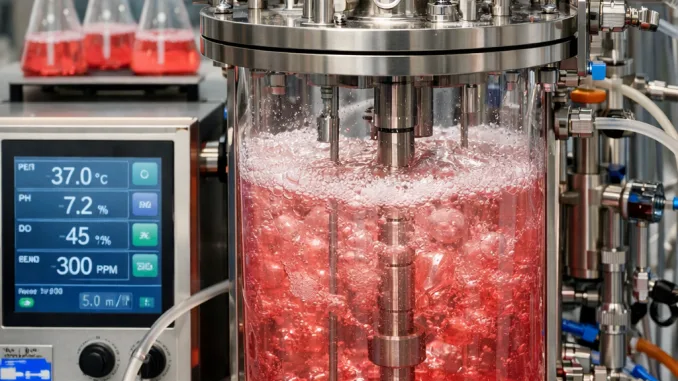
If you want to grow mammalian and plant cells on a commercial scale, then businesses must provide the optimal environment for these cell to grow ‘in vitro’. Without a doubt, key to successful cell growth is the culture medium. Its about using and combining the right nutrients, in the best system with ideal conditions which will produce the highest titres of product. If you look at animal cell culture or systems for producing cultivated meat, they all consider the cell culture media as their number one priority to get right.
What is Cell Culture Media?
A simple definition of any growth medium or culture medium is primarily a liquid or gel that is designed and tailored to support the growth of microorganisms, and plant and animal cells. The media should provide resources of energy and biomolecules, nutrients and other compounds which contribute to cell growth and regulate cell cycle.
A typical medium will contain a full range of amino acids, inorganic salts and minerals, vitamins, carbohydrates such as sugars including glucose, hormones and a serum of growth factors and attachment factors. The medium must be of a suitable pH for the cells and be balanced in its salts so that the osmolality (osmolarity) is appropriate.
The Types of Cell Culture Media
Culture media is divided into two distinct types: natural media and artificial media. Artificial media can be further sub-divided into:-
- chemically defined media
- serum-free media
- protein-free media
- serum containing media
Natural media can take the form of biological fluids, tissue extracts and clots.
Artificial media on the other hand can be balanced salt solutions, synthetic complex media and basal media.
The biological fluids are derived from serum, lymph, plasma, human placental cord serum and amniotic fluid. If you consider tissue extracts then it will include tumours, liver, spleen, bone marrow and leucocytes, and extracts of chick embryo. Clots can be derived from coagulants and plasma clots. All of these fluids are not very well defined apart from their source. The componentry in their composition is not well known and certainly ill-defined.
Of the artificial media, balanced salt solutions can be PBS, HBSS, EBSS and DPBS. These salt solutions usually form the backbone of more complex media to which other components are added. If you consider basal media then this might be MEM and DMEM. These are used for primary and diploid culturing. A complex media might be IMDM or RPMI-1640. These more complex media will help in the culture of mammalian cells.
Serum/Serum Containing Media
Serum contains virtually all the components that cells need for growth. Being natural their exact compistion is not that well defined but they will included proteins, growth factors, growth hormone, minerals and lipids.
The proteins are present for cell attachment and to serve as nutrient carriers. The proteins needed for attachment are fibronectin and alpha-2 microglobulin. These promote cell to substrate interactions. The carriers can be albumin and transferrin. Albumins are carriers of lipids and fat whilst transferrin carries iron in various bioavailable forms.
The growth factors include PDGF, FGF, NGF, EGF and IGF. PDGF has mitogenic activity which means it can induce mitosis which helps with cell proliferation. Additionally, growth hormone such as insulin is present which promotes the uptake of amino acids and glucose by the living cells.
The cell’s metabolic processes are helped by the presence of salts such as sodium, calcium, magnesium and zinc. The latter acts as a cofactor in various enzymes. There may be supplementation with other trace metals too. Lipids will also be present including linoleic acid and oleic acid.
The advantages of serum are being a complete medium with all the components for cell growth. It is only in certain cases that additional materials are needed. It is a viscous medium which helps maintain the viability of the cell by reducing the issues that arise of any shear forces through mixing. There is no need for adding buffering agents because it is already a buffering agent. The presence of proteins is an additional benefit especially the attachment proteins.
The disadvantages are not insignificant. Serum will inhibit the growth of certain cells such as epidermal keratinocytes. Some sera contain cytotoxic components. Foetal calf serum contains the enzyme polyamine oxidase which converts polyamines to polyamino aldehydes that are cytotoxic.
Serum quality is variable and is known to vary between batches. It sometimes means that experimental studies are compromised by the lack of consistency in the cell culture media. Sometimes there is not enough growth factor present and so may need supplementation.
Serum will interfere with downstream processing which increase the costs of processing and purification of any cells or components.
Embryo Extracts
An embryo extract of a chicken will usually be a crude homogenate taken from a 10-day old source. This is clarified by centrifugation. The crude extract can be further fractionated where only a low molecular weight compound extract is created. These are produced because they usually contain peptide growth factors and will promote cell proliferation.
Phosphate Buffered Saline
PBS (phosphate buffered saline) is a salt solution balanced to pH 7.4. Not only is it used for cell culture applications but for washing cells before dissociation, for transporting tissue and cells and when cells are to be counted. Cations such as calcium and magnesium are missing because it is used to remove chelators from cell cultures before cell dissociation. It is does not contain phenol red either.
HBSS (Hanks’ Balanced Salt Solution) is used like PBS but it also contains calcium, magnesium, glucose and phenol red.
Cell Culture Buffers
The regulation of pH is vital for maintaining good cell growth and it is achieved using either a natural buffer system. This system most importantly helps manage the gaseous balance between gaseous carbon dioxide and the bicarbonate/carbonate content in the culture medium. using a natural buffering system means that the atmospheric carbon dioxide is somewhere between 5 and 10% v/v. The natural buffering system is generally of lower cost and non-toxic..
HEPES
HEPES is 4-(2-hydroxyethyl)-1-piperazineethanesulphonic acid. A chemical buffer based on the zwitterion HEPES. It has better buffering capacity in the pH range of 7.2 to 7.4 and does not require the gaseous atmosphere to be controlled. It is expensive and toxic at too high a concentration with some cell types. It can increase the sensitivity of some media to phototoxicity induced by exposure to fluorescent light.
Types of Amino Acids
Amino acids are the building blocks of peptides and proteins and so obligatory ingredients in all types of fermentation media. The essential amino acids must be included in a cell culture medium because cells cannot synthesize these by themselves. They are especially valuable for cell proliferation and their presence will determine the maximum achievable cell density.
One of the most critical is L-glutamine because it contributes nitrogen for NAD, NADPH and for nucleotides. It also serves as a secondary energy sources for metabolism. Unfortunately, L-glutamine is unstable because it converts to an unusable form by cells and so must be added to the media before used.
Trace Elements
Trace elements, usually particular metals are often added to serum-free media to replace those normally present in serum. Particular elements include zinc, selenium and copper which are only needed in very tiny amount for proper cell growth. All these micronutrients are an absolute requirement for most biological processes and are required for the proper functioning of enzymes.
Serum-Free Media
These are media which have a low serum content of about 10 to 20% serum. Cells will be stored and treated using HBSS and HEPES buffer. The cells are usually washed with phosphate buffer saline (PBS).
The benefits of serum-free media are:- there is less variation between batches and so any results of cell growth are consistent between different cell cultivation and reproducible. being less complex than serum, the downstream processing is more straightforward and processes can be designed because there is more concrete knowledge about the amounts and type of components present.
Generally toxic events are significantly reduced because serum toxins are in such small amounts. Any bioassays are more straightforward too because cytotoxins often found in serum are absent. Likewise there are no serum proteases to hydrolyse cellular proteins or indeed other enzyme-sensitive components. Particular contaminants have also been eliminated – viruses and mycoplasma should be absent.
The main issues are that they need to be designed for each particular cell type. It means that a specific design is required when ever a new type of cell line is being developed. Actual serum free formulations are not available.
Compared to serum, the maximum cell density and growth rate are always lower.
The pH and viscosity of serum-free media must be controlled. To maintain pH, a hepes buffer is used and viscosity is increased using the gum CMC (carboxymethylcellulose). A charged substrate is needed too
Commercially Available Serum-Free Media
A few well-known serum-free media are available. These include MCDB 131 (Sigma) for growing endothelial cells and LHC-9 (Invitrogen) used for growing bronchial epithelium.
A number of serum substitutes have been developed for commercial purposes and to replace all or part of the serum in conventional media.
RPMI-1640
Roswell Park Memorial Institute (RPMI) – 1640. A medium developed for the culturing of leukemia cells it is widely used for other types of mammalian cell culturing. Manufactured by Invitrogen.
All these serum-free media my be supplemented with other nutrients including FBS, Tryptose Phosphate Broth and an antibiotic mixture of penicillin, streptomycin and Amphotericin B.
DMEM – Dulbeccos Modified Eagles’ media
IMDM – Iscove’s Modified Dulbecco’s media

Leave a Reply