
Water spinach, scientifically known as Ipomoea aquatica, is a semi-aquatic leafy vegetable that occupies a distinctive place in global agriculture and cuisine. Often referred to as kangkong, ong choy, river spinach, or swamp cabbage, it is native to tropical and subtropical regions of Asia, where it has been cultivated and consumed for centuries. This plant belongs to the same botanical family as the morning glory and sweet potato, a relationship that becomes evident in its vine-like growth habit and characteristic funnel-shaped flowers. Its versatility, rapid growth, and culinary adaptability have made it a staple food in countries such as China, Vietnam, Thailand, Indonesia, and the Philippines, and it is increasingly being explored by gardeners and farmers in temperate regions as well.
Water spinach thrives in warm, wet environments, and its growth habit reflects its adaptability to both aquatic and terrestrial conditions. There are generally two main types: upland varieties, which grow in moist soil, and aquatic varieties, which are cultivated in flooded fields or shallow water systems. The plant produces long, hollow stems and arrow-shaped leaves, with tender young shoots that are particularly prized for consumption. It is a fast-growing species, capable of reaching harvestable size within 30 to 60 days under optimal conditions, making it highly attractive for both subsistence farming and commercial production.
The cultivation of water spinach can take several forms depending on climate and available resources. In traditional tropical agriculture, it is often grown in flooded paddy-like systems, similar to rice cultivation. Farmers plant either seeds or stem cuttings in shallow water, allowing the plants to root and spread across the surface. As the plants establish themselves, water levels are adjusted to match their growth stage, ensuring that the stems remain partially submerged while the leaves are exposed to sunlight. This method produces lush, clean foliage and can yield substantial harvests. Alternatively, in upland systems, water spinach is grown in raised beds with irrigation channels on either side. These beds are kept consistently moist, and fertilisers are applied to encourage rapid growth.
In more temperate climates, including parts of Europe and the United Kingdom, water spinach is typically grown as an annual crop due to its sensitivity to cold temperatures. The plant thrives at temperatures between approximately 23 and 29°C and is damaged by frost or prolonged exposure to temperatures below about 10°C. As a result, growers in cooler regions often use greenhouses, polytunnels, or container systems to maintain the necessary warmth and moisture. Seeds are usually soaked before sowing to encourage germination, planted shallowly in moist soil, and kept in warm conditions until sprouting occurs. Once established, the plants require consistent watering and access to sunlight, and they can be harvested repeatedly by cutting the young shoots, which regrow quickly.
Propagation of water spinach is straightforward, contributing to its popularity among growers. It can be grown from seeds or from cuttings taken from mature plants. Seed propagation involves planting the seeds in warm, moist soil and maintaining consistent humidity until germination, which typically occurs within two to three weeks. However, many farmers prefer vegetative propagation using cuttings, as this method produces faster and more uniform growth. Cuttings are simply inserted into wet soil or shallow water, where they quickly develop roots and begin to spread. This ease of propagation, combined with the plant’s rapid growth rate, allows for multiple harvests within a single growing season.
The supply of water spinach seeds has expanded globally as interest in the plant has grown beyond its traditional regions. Seeds are commonly distributed by specialist seed companies, particularly those focusing on Asian vegetables or exotic crops. Online retailers and nurseries offer packets of seeds labelled with the botanical name Ipomoea aquatica, often emphasising the importance of choosing authentic, non-hybrid varieties to ensure proper growth. Suppliers typically provide guidance on sowing, germination, and cultivation, reflecting the plant’s increasing popularity among home gardeners. In addition, some growers obtain planting material directly from fresh market produce, using stem cuttings from purchased plants to propagate new crops, a practice that highlights the plant’s accessibility and resilience.

Despite its advantages, the cultivation of water spinach is not without challenges or considerations. In some regions, particularly parts of the United States, it is classified as a potentially invasive species due to its rapid growth and ability to spread in aquatic environments. This has led to regulatory restrictions on its cultivation in certain areas, requiring growers to check local guidelines before planting. The concern stems from the plant’s capacity to outcompete native vegetation in waterways, which could disrupt local ecosystems. However, when grown responsibly in controlled environments such as containers or managed fields, these risks can be mitigated.
Culinarily, water spinach is valued for its mild, slightly sweet flavour and its unique texture, which combines crisp stems with tender leaves. It is an integral ingredient in a wide variety of dishes across Southeast and East Asia, where it is used in stir-fries, soups, curries, and salads. One of the most common preparations involves quickly stir-frying the young shoots with garlic, chilli, and soy sauce, creating a simple yet dekicious dish that highlights the plant’s natural qualities. Variations of this dish may include additional ingredients such as shrimp paste, oyster sauce, or fermented bean paste, depending on regional preferences.
In Vietnamese cuisine, it is known as rau muống.
In Thai cuisine, water spinach is often stir-fried with oyster sauce and chillies, while in Chinese cooking it may be combined with bean curd or fermented sauces. In the Philippines, it is commonly sautéed with garlic, onions, and meat such as pork or chicken, sometimes forming part of a larger dish like sinigang or adobo. Vietnamese cuisine incorporates water spinach into soups and salads, and it may also be blanched and served with dipping sauces. Across these culinary traditions, the plant’s versatility allows it to absorb and complement a wide range of flavours, making it a staple vegetable in many households.
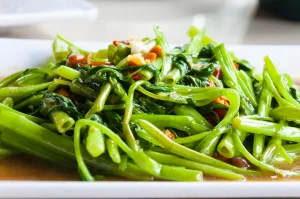
Beyond stir-fries, water spinach is used in a variety of other preparations. It can be steamed or boiled and served as a side dish, added to noodle soups for texture and nutrition, or incorporated into curries where it absorbs the rich flavours of spices and coconut milk. In some cases, the leaves are battered and deep-fried, creating a crispy snack or accompaniment. The plant is also occasionally eaten raw in salads, particularly when the shoots are young and tender. Its nutritional profile, which includes vitamins, minerals, and dietary fibre, further enhances its appeal as a healthy and versatile ingredient.
In addition to its culinary uses, water spinach has applications in agriculture and aquaculture. It is sometimes grown as a fodder crop for livestock due to its high nutritional value, and it can be integrated into aquaponic systems where it helps filter water while providing edible biomass. Its rapid growth and ability to thrive in waterlogged conditions make it suitable for such integrated systems, contributing to sustainable farming practices. Moreover, its adaptability allows it to be cultivated in small spaces, including containers and urban gardens, making it accessible to a wide range of growers.
The global spread of water spinach reflects broader trends in agriculture and cuisine, where traditional crops are being rediscovered and adapted to new environments. As interest in diverse and nutritious vegetables grows, water spinach offers a compelling combination of ease of cultivation, high productivity, and culinary versatility. Its ability to grow in challenging conditions, including waterlogged soils and hot climates, makes it particularly valuable in regions where other leafy greens may struggle. At the same time, its incorporation into international cuisines demonstrates the fluid exchange of culinary practices in an increasingly interconnected world.
Water spinach is a remarkable plant that bridges the domains of agriculture, ecology, and cuisine. It is grown using a variety of methods, from traditional flooded fields to modern greenhouse systems, and is supplied through an expanding network of seed producers and nurseries. Its role in cooking spans a wide array of dishes, particularly in Asian cuisines, where it is celebrated for its flavour and adaptability. While it requires careful management in certain environments due to its vigorous growth, its benefits as a fast-growing, nutritious, and versatile crop ensure that it will continue to be cultivated and enjoyed around the world.
Related Posts
 Growing Caraway
A hardy biennial which flowers the following year from sowing. Seeds are a wonderful seasoning…
 Is Lemon Water Better Than Ordinary Water ?
Lemon water is a very trendy drink which to many has almost magical and mystical…
- Vietnamese Spinach and Tofu Soup
An interesting vietnamese dish is spinach and tofu soup which is also known as canh…
 Growing Rosemary
Rosemary (Rosmarinus officinalis) has been grown throughout the middle and southern countries of Europe for…
Leave a Reply