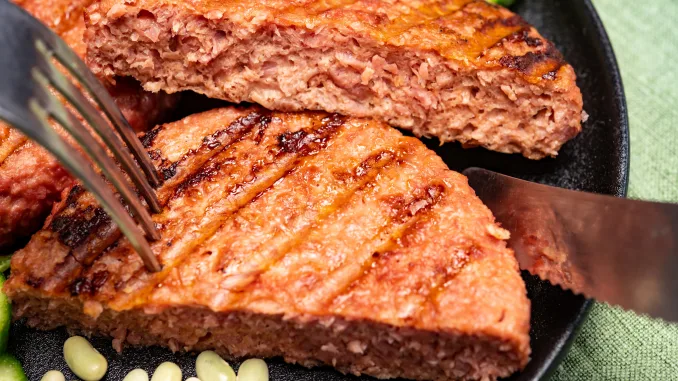
High-moisture extrusion (HME) is a thermomechanical processing technology primarily used to create dense, fibrous structures from protein-rich formulations. It is most widely associated with plant-based meat analogues and high-moisture meat analogues (HMMA) but is also applied in specialty feed, texturized proteins but not low-moisture meat analogues or the majority of texturised vegetable proteins[TVP], and emerging biomaterials. I have covered it briefly in an earlier post on creating meat analogues.
This particular technology has many advantages over extrusion processes especially the more traditional and better researched low to intermediate methods of moisture extrusion. There are good reviews and research articles by Cheftel et al., 1992; Yao et al., 2004 & Liu & Hsieh, 2008 generally on the subject of processing and where it started. The plant proteins themselves are covered off by Jones (2016).
Most of this article comes from an assessment of these principal papers.
1. Fundamental Concept
High-moisture extrusion operates at total moisture contents typically between 40–80% (wet basis), substantially higher than conventional low-moisture texturization (20–35%). The process uses heat, pressure, shear, and controlled cooling to transform hydrated biopolymers—mainly proteins—into anisotropic, meat-like structures.
The defining feature is the cooling die, which allows molecular alignment to be “locked in” under laminar flow conditions rather than expanding into a porous product.
The cooling die is where any original plant structures are deformed, fractionated and reorganized to produce the desired textures and fibrous structures that characterise different meat analogs.
The main process parameters characterising any extrusion process are summarized as:-
- barrel temperature
- screw speed
- feed rate
- moisture content
- ingredient type and composition
The system parameters which are usually determined by an empirical approach are:-
- pressure
- SME
- temperature of the feedstock
A parallel approach, the mechanistic approach to understanding the process looks at the physical characteristics. These include:-
- solubility
- viscosity
- molecular weight distribution
All these parameters determine the characteristics of the final product which are:-
- product morphology
- texture such as hardness and softness
- structure such as fibrosity and gelification
- colour
Viscosity of a food material usually decreases as temperature and moisture content rises but exceptions are seen with food hydrocolloids and polymers. In HMEC materials, when the temperature is as high as 180°C and the moisture content is greater than 50C, the molecular mobility of molten polymers improves and there is some polymer breakdown which decreases viscosity (Akdogan, 1996).
2. Process Flow and Equipment
2.1 Key Process Stages
The process in outline is the following:
-
Raw material feeding
-
Protein concentrates/isolates (mainly soy, pea, wheat gluten, fava, etc.)
-
Water and functional additives (lipids, fibers, salts, flavours)
- Carbohydrates – small sugars, polymers
-
-
Hydration and mixing
-
Initial wetting and dispersion in the extruder barrel
-
-
Thermomechanical transformation
-
Protein denaturation
-
Partial unfolding and aggregation
-
Viscous melt formation
-
-
Alignment and structuring
-
Shear and elongational flow orient protein domains
-
-
Cooling and solidification
-
Gradual temperature reduction under pressure
-
Structure fixation without expansion
-
2.2 Extruder Configuration
In the production of high-moisture food products, the configuration of the extruder is a critical determinant of product quality, process stability, and operational efficiency. High-moisture systems—typically containing water contents above 40 percent—exhibit complex rheological behavior that is highly sensitive to thermal, mechanical, and shear conditions. The extruder configuration governs how these variables are generated, distributed, and controlled throughout the process. The main parameters are:
-
Twin-screw extruders (co-rotating, intermeshing) are standard
-
Superior mixing
-
Precise shear and residence-time control
-
-
L/D ratios typically 24:1 to 48:1
-
Barrel temperatures: ~110–180 °C (protein-dependent)
-
Screw speeds: ~200–600 rpm
-
Specific mechanical energy (SME) is a critical control parameter
Typical experimental systems use a Brabender TSE 20/40 (CW Brabender Instruments Inc.). A typical set-up is explained by Wagner & Ganjyal (2024).
Screw design is central to this configuration. The selection and arrangement of conveying, kneading, and mixing elements directly influence residence time, shear intensity, and pressure development. In high-moisture applications, excessive shear can lead to phase separation, protein degradation, or undesirable textural collapse, while insufficient shear may result in poor mixing and incomplete structuring. A properly configured screw profile ensures uniform hydration of raw materials and controlled alignment of biopolymers, which is essential for achieving consistent texture and mouthfeel.
Barrel zoning and temperature control further underscore the importance of extruder configuration. High-moisture products require precise thermal management to promote functional transformations—such as protein denaturation or starch gelatinization—without inducing localized overheating. Configurations that allow independent barrel temperature zones enable gradual energy input, minimizing thermal shock and maintaining product integrity.
Die and downstream configuration also play a decisive role. The pressure and flow conditions established by the upstream screw and barrel design directly affect die stability and product expansion or structuring. In high-moisture extrusion, where expansion is often suppressed in favor of dense or fibrous structures, the extruder must be configured to maintain steady pressure and laminar flow through the die.
Ultimately, extruder configuration defines the balance between mechanical energy, thermal input, and material transformation. In high-moisture food production, this balance is particularly delicate. A well-engineered extruder configuration not only enables consistent, high-quality products but also reduces process variability, energy consumption, and the risk of operational failure.
2.3 Cooling Die
-
Long slit or annular die
-
Actively temperature-controlled (often 20–80 °C gradient). These are often just water cooled.
-
Maintains pressure while reducing thermal motion
-
Enables formation of layered or fibrous morphology
The cooling die plays a critical role in the extrusion of high-moisture food products, as it directly influences product structure, safety, and quality. In high-moisture extrusion (HME), ingredients typically contain more than 40–60% water and are processed at elevated temperatures and pressures to form fibrous or layered structures. It is the final and most decisive stage in locking in these fibrous structures.
As the molten food matrix exits the extruder, it is in a highly plasticized and unstable state. Without rapid and controlled cooling, the product would expand, collapse, or lose its desired alignment due to steam flashing and pressure release. The cooling die reduces the temperature of the product below its melting or glass transition point while maintaining pressure, preventing sudden vaporization of water. This controlled cooling enables the protein and polysaccharide networks to solidify in an ordered manner, preserving the anisotropic, fibrous texture that defines high-moisture extruded foods.
In addition to textural control, the cooling die ensures dimensional stability and uniformity. By precisely managing temperature gradients and residence time, the die minimizes internal stresses, warping, and surface defects. This consistency is essential for downstream processing such as cutting, packaging, or further thermal treatment.
The cooling die also has implications for food safety and shelf life. Effective heat removal helps bring the product into a temperature range that limits microbial growth and reduces the risk of structural breakdown caused by residual thermal energy. Furthermore, uniform cooling prevents localized overcooking or under processing, which can negatively affect flavour, colour, and nutritional quality.
The cooling die is not merely a shaping component but a critical control point in high-moisture extrusion. It governs texture formation, structural integrity, and product consistency, making it indispensable in the production of high-quality high-moisture food products.
3. Physicochemical Mechanisms
The formation of fibres using HMC is still being worked out although some basic biochemical methods are being explored.
3.1 Protein Transformations
-
Denaturation: Unfolding of native protein structures
-
Aggregation: Formation of new intermolecular bonds
-
Disulfide bonds
-
Hydrogen bonding
-
Hydrophobic interactions
-
3.2 Structure Formation
-
Shear-induced alignment of protein aggregates
-
Phase separation between protein-rich and water-rich domains
-
Laminar flow → anisotropic texture (fiber directionality)
Water acts as:
-
Plasticizer
-
Heat transfer medium
-
Mobility facilitator for molecular alignment
The structural effects of both covalent and non-covalent bond formation in proteins have been assessed but unravelling the kinetic elements in fibre formation have proved difficult to understand (Chen et al., 2011). Covalent bonds of particular relevance are the peptide bonds between amino acids and those that are involved in cross-linking. These include cross-links between proteins using lysine for example, disulphide links and ether bridges. Maillard reactions are also instrumental in extrusion processes generally (Fu et al., 2020). They occur between proteins and sugars in the feedstock. The products are generally browner because they ultimately produce caramelization. Non-covalent bonding occurs in the form of hydrophobic interactions, hydrogen bonding and Wan Der Waals interactions. All these interactions contribute to the three-dimensional structure of proteins.
A critical chemical reaction occurring in the formation of fibres is the cross-linking of proteins using disulphide bonds. Extrusion has a significant role to play in their formation because the level of cross-linking increases the fibrous nature and thus texture of the protein.
Reducing agents affect protein texture. Theoretically, they should reduce the fibrous texture of proteins because they cleave disulphide bonds in the extrudate if they are present and added. A wheat protein extrusion method was assessed with low amounts of reducing agents between 0.01% and 0.75% being added. These were sodium metabisulfite, glutathione, and cysteine. Oddly there was an increase fibrous texture when sodium metabisulphite and cysteine was added to 0.5% (Richter et al., 2024). It was reasoned that reducing agents break the disulphide bonds early on in the extrusion process. This improves melt flow during extrusion and encourages cross-linking between the proteins .
4. Product Characteristics
Typical outcomes include:
-
Dense, non-expanded products
-
Fibrous, layered internal structure
-
High water-holding capacity
-
Chewiness and tensile strength resembling muscle tissue
Mechanical properties are often characterized using:
-
Texture Profile Analysis (TPA)
-
Tensile testing (parallel vs. perpendicular to fiber direction)
-
Microstructural imaging (SEM, CLSM)
5. Critical Process Variables
| Variable | Impact |
|---|---|
| Moisture content | Controls viscosity, alignment, and density |
| Barrel temperature | Affects denaturation and bonding |
| Screw configuration | Determines shear and mixing intensity |
| SME | Correlates with texture and fiber formation |
| Cooling rate | Influences structural stability |
| Die geometry | Controls flow regime and alignment |
6. Applications
6.1 Food
-
Plant-based whole-cut meat analogues (chicken, beef, fish)
-
Hybrid products (plant + animal proteins)
-
Cheese and seafood analogues (emerging)
6.2 Feed and Other Uses
-
High-value pet food
-
Aquafeed with improved water stability
-
Biopolymer structuring research (non-food)
7. Advantages and Limitations
Advantages
-
Continuous, scalable process
-
No chemical solvents
-
High product realism
-
Efficient protein structuring
Limitations
-
Capital-intensive equipment
-
Narrow operating windows
-
Sensitivity to raw material variability
-
Complex scale-up behavior
8. Comparison to Low-Moisture Extrusion
| Aspect | High-Moisture | Low-Moisture |
|---|---|---|
| Moisture | 50–80% | 20–35% |
| Expansion | None | High |
| Texture | Fibrous, dense | Porous, sponge-like |
| Die | Cooling die | Short, heated die |
| Post-processing | Minimal | Rehydration required |
9. Current Research Trends
-
Novel protein sources (fungal, algal, insect-derived)
-
Multiphase systems (protein–fat–fiber structuring)
-
Inline structure monitoring
-
Energy-efficient screw and die designs
-
Predictive modeling of protein alignment
References
Akdogan, H. (1996). Pressure, torque, and energy responses of a twin screw extruder at high moisture contents. Food Research International, 29(5-6), pp. 423-429.
Cheftel, J. C., Kitagawa, M., & Quéguiner, C. J. F. R. I. (1992). New protein texturization processes by extrusion cooking at high moisture levels. Food Reviews International, 8(2), pp. 235-275 (Article).
Chen, F. L., Wei, Y. M., & Zhang, B. (2011). Chemical cross-linking and molecular aggregation of soybean protein during extrusion cooking at low and high moisture content. LWT-Food Science and Technology, 44(4), pp. 957-962
Fu, Y., Zhang, Y., Soladoye, O. P., & Aluko, R. E. (2020). Maillard reaction products derived from food protein-derived peptides: Insights into flavor and bioactivity. Critical Reviews in Food Science and Nutrition, 60(20), pp. 3429-3442.
Jones, O. G. (2016). Recent advances in the functionality of non-animal-sourced proteins contributing to their use in meat analogs. Current Opinion in Food Science, 7, pp. 7-13. .
Liu, K., & Hsieh, F. H. (2008). Protein–protein interactions during high-moisture extrusion for fibrous meat analogues and comparison of protein solubility methods using different solvent systems. Journal of Agricultural and Food Chemistry, 56(8), pp. 2681-2687.
Osen, R., Toelstede, S., Eisner, P., & Schweiggert-Weisz, U. (2015). Effect of high moisture extrusion cooking on protein–protein interactions of pea (Pisum sativum L.) protein isolates. International Journal of Food Science and Technology, 50(6), pp. 1390-1396. .
Richter, J. K., Smith, B., Saunders, S. R., Finnie, S. M., & Ganjyal, G. M. (2024). Protein functionality is critical for the texturization process during high moisture extrusion cooking. ACS Food Science & Technology, 4(5), pp. 1142-1151.
Wagner, C. E., & Ganjyal, G. M. (2024). Impact of functional dietary fiber incorporation on the appearance and mechanical properties of extruded high moisture meat analogs. Journal of Food Science, 89(8), pp. 4953-4968
Yao, G., Liu, K. S., & Hsieh, F. (2004). A new method for characterizing fiber formation in meat analogs during high‐moisture extrusion. Journal of Food Science, 69(7), pp. 303-307.

Leave a Reply