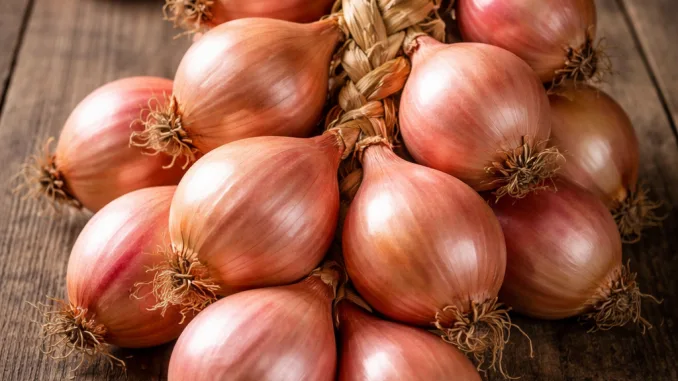
The Roscoff onion is immediately distinguishable by its coppery-rose skin and elongated, slightly flattened globe shape. When cut open, it reveals a pale pink to ivory flesh, firm and dense, with a fine-grained texture. Unlike more pungent yellow storage onions, the Roscoff variety is notable for its balanced organoleptic properties: it possesses a pronounced sweetness, moderate sulfur compounds, and a persistent aromatic finish that lingers without overwhelming the palate. This equilibrium between sugar content and mild allium heat is one of the principal reasons it is considered a delicacy. The sugars—primarily fructose and glucose—are present in relatively high concentrations, while the pyruvic acid levels, often used as a proxy for pungency in onion cultivars, remain comparatively restrained. The result is an onion that can be consumed raw with pleasure, yet develops extraordinary depth when cooked.
The delicacy status of the Roscoff onion is further reinforced by its protected designation. It holds the French Appellation d’Origine Protégée (AOP), a certification that guarantees not only geographic origin but also adherence to strict production specifications. The cultivation zone is tightly circumscribed around the Léon region of northern Finistère, where a unique combination of sandy-loam soils and a temperate oceanic climate creates ideal growing conditions. The soils are well-drained yet rich in organic matter, often enriched historically with seaweed harvested from the nearby coast. The Atlantic influence moderates temperature extremes, reducing frost risk in winter and excessive heat in summer, while the saline air contributes subtle mineral nuances to the terroir. In viticultural terms, one might describe Roscoff onions as an expression of maritime agriculture, their character inseparable from place.
Cultivation of Roscoff onions remains labor-intensive and highly regulated. The production cycle begins with sowing in seedbeds during winter, often in January or February. The seedlings are then transplanted by hand into open fields in early spring, a practice that allows farmers to select the most vigorous plants and ensure uniform spacing. This manual transplantation is not merely tradition but a functional agronomic choice, promoting consistent bulb development and facilitating mechanical weed control between rows. Throughout the growing season, producers monitor irrigation carefully; while Brittany receives regular rainfall, drainage must be sufficient to prevent bulb rot. The sandy soils assist in this regard, preventing waterlogging and encouraging the development of well-formed, firm bulbs.
By late summer, typically August, the onions reach maturity. Harvesting is conducted with care to avoid bruising the outer skins, which are integral to both shelf life and aesthetic appeal. Once lifted, the onions are cured in the open air or under ventilated shelters. Curing is a critical post-harvest phase: it allows the neck tissues to desiccate and the outer scales to dry, forming a protective barrier against microbial invasion. Proper curing enhances storability, a characteristic for which Roscoff onions are renowned. Historically, their excellent keeping quality enabled Breton farmers to export them to Great Britain during the nineteenth century. The so-called “Onion Johnnies,” Breton traders who traveled door-to-door in England selling strings of pink onions, became cultural icons, and the Roscoff onion was central to that trade.
One of the most visually distinctive aspects of Roscoff onions is their braiding. After curing, the onions are often plaited into long strings, sometimes containing dozens of bulbs. This practice is not merely decorative; it facilitates air circulation, prolonging storage life, and allows for convenient transport and market display. The braided form has become emblematic of the product itself, signaling artisanal authenticity and regional identity. In markets across Brittany, and increasingly throughout France and beyond, these pink braids function as both culinary ingredient and symbol of heritage agriculture.
The flavour profile of Roscoff onions lends itself to a wide array of culinary applications. In raw preparations, their mildness and sweetness make them suitable for salads, vinaigrette-dressed crudités, and garnishes for seafood. Finely sliced, they can accompany oysters or smoked fish without overpowering delicate marine flavours. Their textural firmness ensures that even thin slices retain a pleasant bite, avoiding the flaccidity sometimes associated with other varieties. In classic French cuisine, they are frequently used in tartes à l’oignon, where their natural sugars caramelize gently during baking, producing a nuanced sweetness that contrasts with savory custard and pastry.
When subjected to heat, Roscoff onions undergo a controlled Maillard reaction and caramelization, intensifying their inherent sweetness while developing notes of hazelnut and light toffee. In slow-cooked preparations such as confit d’oignons, the variety’s high sugar content yields a silky, jam-like consistency without the need for excessive added sugar. This makes them ideal for pairing with foie gras, terrines, or aged cheeses, where a subtle sweet counterpoint is desirable. They are also exemplary in soups, particularly the canonical soupe à l’oignon. Although any onion can be used for this dish, Roscoff onions produce a broth of greater aromatic complexity and less harshness, reducing the need for prolonged cooking to mellow pungency. We have created a veloute recipe to showcase this particular onion but I know of chefs who have used them in the classic French onion soup too.
Beyond traditional French fare, contemporary chefs have embraced Roscoff onions in modern gastronomy. Their balanced flavour profile makes them adaptable to global cuisines: they can be pickled lightly for use in Nordic-style open sandwiches, incorporated into chutneys alongside cider vinegar and Breton apples, or slow-roasted whole as a vegetal centerpiece. The elongated shape allows for attractive presentation when halved and caramelized cut-side down, creating visually appealing plates in fine-dining contexts. Their sweetness also pairs effectively with seafood, particularly scallops and white fish, reflecting the maritime environment from which they originate.
Nutritionally, Roscoff onions share many attributes common to Allium cepa varieties: they contain dietary fiber, vitamin C, and bioactive compounds such as quercetin. However, it is their sensory and cultural capital rather than purely nutritional profile that elevates them to delicacy status. The AOP framework enforces production limits, ensuring that supply remains relatively constrained and quality standards remain high. This controlled production, combined with labor-intensive methods and strong regional branding, positions Roscoff onions in a premium market segment.
Ultimately, the Roscoff onion exemplifies the intersection of terroir, tradition, and taste. Its delicacy derives not only from sweetness or mildness but from the coherence of an entire system: specific soils shaped by centuries of maritime agriculture, disciplined cultivation practices, careful post-harvest handling, and a culinary culture that knows how to exploit its virtues. To eat a Roscoff onion—whether raw in a simple salad or slowly caramelized atop a golden tart—is to participate in a lineage that stretches back generations along the Breton coast. In a globalized food economy often characterized by standardization, the Oignon de Roscoff remains a reminder that distinctiveness, when rooted in place and protected by rigorous standards, can transform an everyday vegetable into a gastronomic treasure.
Leave a Reply