Stouffer’s began not as a frozen-food conglomerate but as a modest Cleveland milk stand whose timing and recipes captured a moment in American eating habits. In 1922 Abraham E. Stouffer and his wife Lena converted a milk-and-sandwich counter in the Arcade building into a lunchtime spot where Lena’s Dutch apple pie and straightforward, high-quality home cooking quickly distinguished the operation from the competition. That small success—grown by the next generation of Stouffer family managers into a standardized, multi-unit restaurant operation—laid the cultural and culinary groundwork for the brand’s pivot into packaged foods after World War II, when demand for convenient, restaurant-quality meals outside the dining room began to rise.
From the restaurant floor to the frozen-food aisle was a natural progression: customers asked to take favorites home, Stouffer’s began packaging popular items, and by the 1950s the company had moved from small-scale packing to mass production of frozen entrées. Stouffer’s early frozen portfolio emphasized comfort-food dishes that could survive freezing and reheating while preserving a sense of homemade technique—lasagna, pot roast, meatloaf, and souffle among them—positioning the brand as a bridge between full-service restaurant quality and household convenience. The company’s investments in processing and standardization allowed it to claim a higher culinary pedigree than many competitors, a selling point the brand has exploited ever since.
Corporate ownership and strategy shifted markedly in the 1970s when Stouffer’s—after a period as part of Litton Industries—was acquired by Nestlé in 1973. Under Nestlé’s ownership the Stouffer’s name became the foundation for a broader frozen-foods division and a platform for innovation, including the launch of low-calorie, portion-controlled sub-brands and the scaling of distribution into supermarkets across North America. The Nestlé era also saw Stouffer’s transition away from operating hotels and restaurants as the company progressively focused on consumer packaged goods; by the 1990s and into the 21st century the Stouffer’s identity had become primarily synonymous with frozen entrees.
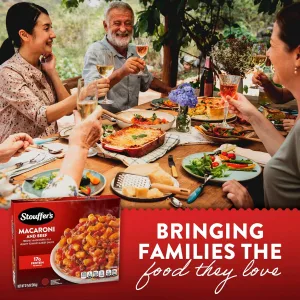
Product development at Stouffer’s reflects three linked imperatives: taste retention under frozen (and, more recently, shelf-stable) conditions; convenience and portioning for contemporary households; and trust through familiarity. Classic core SKUs — lasagna, macaroni and cheese, chicken pot pie, Salisbury steak, and fettuccine Alfredo — have been iterated in single-serve microwave trays, family-size foil pans, and “party size” formats for larger gatherings. The brand has traditionally segmented offerings by occasion and channel: single-serve frozen entrees for on-the-go consumers, family and party sizes for weeknight dinners and entertaining, and food-service formulations for institutional buyers. Over decades Stouffer’s also built a reputation for certain signature items—spinach souffle and meat lasagna among them—that function as both product and brand shorthand.
In response to shifting consumer health preferences, Stouffer’s incubated and spun out Lean Cuisine in 1981 as a lower-calorie extension of its frozen repertoire. Lean Cuisine began with a small set of offerings under strict calorie and nutritional guidelines and grew into a sizeable sub-brand that addressed the market for portion-controlled, diet-oriented frozen meals; this move broadened Stouffer’s commercial footprint and gave Nestlé another tool to compete across different shopper motivations. The Lean Cuisine story also illustrates the brand’s adaptive model: when demographic or lifestyle trends change, Stouffer’s and its parent company have historically created targeted variants rather than attempting to rebrand the entire portfolio.
Innovation continued into the 21st century both in product form and category reach. While frozen entrees remain the brand’s bedrock, recent years have seen Stouffer’s experiment beyond the freezer aisle. In 2024 the company introduced “Stouffer’s Supreme” shelf-stable macaroni and cheese—boxed, stovetop-prepared products designed to compete in the large, value-driven boxed mac-and-cheese category dominated historically by other legacy brands. This launch signaled a strategic willingness to trade on Stouffer’s culinary reputation in adjacent, non-frozen formats and to pursue growth in snacking and pantry segments where frequency of purchase is high. Nestlé framed the move as leveraging Stouffer’s comfort-food equity while addressing shoppers’ desire for better-tasting, accessible pantry staples.
The Stouffer’s portfolio today is therefore best understood as layered: core frozen classics (single-serve and family/party sizes), health-focused and lifestyle variants (originally Lean Cuisine), seasonally refreshed and promotional SKUs, and exploratory extensions into shelf-stable and limited-distribution innovations. Packaging and formulation have evolved in parallel: microwavable trays, foil pans with oven directions, microwavable bowls, and boxed mixes each require distinct R&D to preserve texture and flavor—an engineering challenge the brand has repeatedly emphasized in its marketing and technical communications. The product architecture also allows retailers to plan assortment by aisle and shopper mission: freezer for indulgent entrees, perimeter or frozen singles for convenience, and the pantry for new Stouffer’s Supreme items.
Like any major food brand, Stouffer’s has faced product-safety and quality incidents that shape consumer perceptions. Nestlé USA has, on occasion, issued recalls affecting Stouffer’s and related Lean Cuisine items when contaminants were reported; these responses underscore the modern reality that large, multi-format food portfolios require vigilant supply-chain oversight and rapid regulatory engagement. Such episodes have led to tighter traceability measures and clearer communication protocols, but they also remind consumers that convenience foods sit atop complex manufacturing systems with attendant risks.
Culturally and commercially, Stouffer’s endurance rests on three durable assets: a lineage anchored in restaurant quality and a family-cook heritage; a product portfolio centered on familiar comfort dishes with broad appeal; and a corporate parent with the scale and distribution to place those dishes in millions of freezers. The brand’s future will likely follow the twin axes of format diversification (more shelf-stable and convenience formats) and nutritional segmentation (protein-forward, portion-controlled, or ingredient-transparent variants) as consumer habits continue to bifurcate. For consumers, Stouffer’s remains shorthand for convenient, reliably comforting meals; for the market, it is a case study in how a dining-room origin can be industrialized without entirely shedding the sensory cues and recipes that made it special in the first place.
If you’d like, I can produce a concise timeline of the brand’s milestones, an annotated list of current SKUs across format types, or a brief competitor comparison (Lean Cuisine, Healthy Choice, Marie Callender’s) to show where Stouffer’s sits on price, taste positioning, and innovation.
Stand-Out Products
Click On This Link To Purchase This Product (USA Only) .
- Dive into delicious with our savory STOUFFER’S CLASSICS Chicken Fettuccini Alfredo
- Made with ingredients you can feel good about for a homemade taste you’ll love
- Grilled white meat chicken, broccoli and fettuccini in a creamy Alfredo sauce
- Use a microwave or conventional oven to dig into an easy-to-prepare family favorite


Leave a Reply