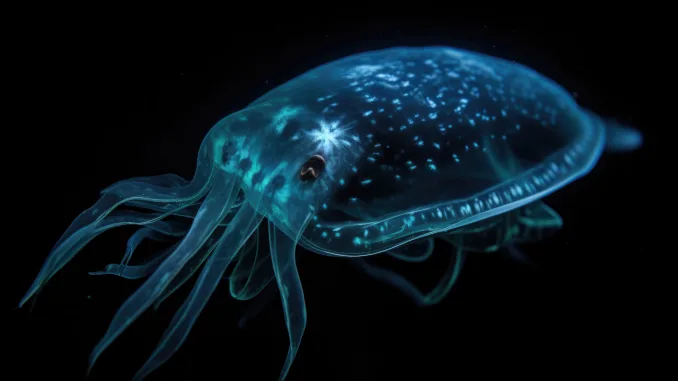
Quorum sensing (QS) is a conserved mechanism used by bacteria to coordinate group behaviors in response to changes in population density. It allows microbial communities to regulate gene expression through the production, release, and detection of small diffusible signaling molecules called autoinducers. Vibrio fischeri—also referred to as Aliivibrio fischeri—is the classic model organism for studying quorum sensing, best known for regulating bioluminescence in symbiosis with the Hawaiian bobtail squid (Euprymna scolopes).
When V. fischeri colonizes the squid’s light organ, the light it produces camouflages the squid by matching the downwelling moonlight in a process called counterillumination. Importantly, luminescence occurs only when the bacteria reach a high enough cell density, which is detected and controlled through quorum sensing.
This article will examine how quorum sensing regulates bioluminescence in V. fischeri, focusing on the LuxI–LuxR system, auxiliary systems such as AinS–AinR and LuxS–LuxP/Q, and the integrated regulatory cascade that ties these signals together. It will also discuss the significance of this regulation in the squid symbiosis and the broader biological implications of quorum sensing.
1. The Core LuxI–LuxR System
The primary quorum sensing circuit in V. fischeri is the LuxI–LuxR system. LuxI is an enzyme that synthesizes the autoinducer N-(3-oxo-hexanoyl)-homoserine lactone (3-oxo-C6-HSL). As the bacterial population grows, this molecule accumulates inside and outside the cells. Once it reaches a threshold concentration, it binds to LuxR, a transcriptional activator protein. The LuxR–autoinducer complex activates transcription of the lux operon (luxICDABEG), which encodes luciferase and other enzymes needed for light production.
Luciferase catalyzes the luminescent reaction, using reduced flavin mononucleotide and a long-chain aldehyde to generate visible blue-green light. Importantly, the LuxR–autoinducer complex also activates luxI, creating a positive feedback loop. This amplification ensures that once the quorum threshold is reached, the system switches rapidly from a non-luminous to a luminous state across the entire bacterial population.
2. Auxiliary Quorum Sensing Systems
While the LuxI–LuxR circuit is central, V. fischeri also possesses additional quorum sensing systems that modulate luminescence and other symbiotic behaviors. These include the AinS–AinR system and the LuxS–LuxP/Q system.
2.1 AinS–AinR System
AinS produces a different signal molecule, N-octanoyl-HSL (C8-HSL), which is detected by the sensor kinase AinR. At moderate population densities, this system influences a phosphorelay cascade that ultimately feeds into the main quorum sensing pathway and contributes to the regulation of luminescence.
Interestingly, C8-HSL can also bind directly to LuxR, though less effectively than 3-oxo-C6-HSL. At certain concentrations, it can even compete with the stronger signal, fine-tuning the luminescence response. This system plays a major role during the early stages of symbiosis, when bacterial populations are still growing inside the squid’s light organ.
2.2 LuxS–LuxP/Q System
The LuxS enzyme produces another signal molecule, autoinducer-2 (AI-2), which is detected by the LuxP–LuxQ receptor complex. Like the AinS–AinR pathway, LuxS–LuxP/Q connects into the same phosphorelay network, modulating downstream regulators that control bioluminescence.
Although AI-2 signaling seems less critical for luminescence than the LuxI–LuxR and AinS–AinR systems, it provides additional layers of regulation, particularly under certain environmental conditions. This redundancy highlights the importance of robust control in symbiotic signaling.
3. Integrated Regulatory Cascade: LuxU → LuxO → Qrr1 → LitR
The multiple quorum sensing signals converge on a shared phosphorelay system that integrates information about bacterial population density. The key players in this cascade are LuxU, LuxO, Qrr1, and LitR.
At low autoinducer levels, sensor kinases like AinR and LuxQ phosphorylate LuxU, which then transfers the phosphate to LuxO. Phosphorylated LuxO activates transcription of a small regulatory RNA called Qrr1. In association with the RNA chaperone Hfq, Qrr1 destabilizes the mRNA of litR, reducing production of the LitR transcription factor. With low LitR levels, expression of luxR remains limited, and the lux operon is not strongly activated—keeping luminescence off at low densities.
As autoinducers accumulate with increasing bacterial density, AinR and LuxQ switch from kinase to phosphatase activity, dephosphorylating LuxO. This silences Qrr1 expression, allowing LitR levels to rise. LitR then activates transcription of luxR, increasing LuxR protein levels. With abundant LuxR available, the LuxI–LuxR system becomes highly responsive to autoinducers, rapidly activating the lux operon and producing bright light.
This integrated design allows V. fischeri to finely tune its behavior across a gradient of cell densities, ensuring luminescence occurs only when the population is sufficiently dense.
4. Bioluminescence in Symbiosis
In the squid light organ, quorum sensing ensures that luminescence occurs in a highly regulated manner, conserving energy and maximizing the benefits of the symbiosis. At early stages of colonization, C8-HSL signaling plays a leading role, producing low levels of light. As the population expands, 3-oxo-C6-HSL signaling takes over, driving full induction of the lux operon and strong light production.
This regulation is critical not only for counterillumination but also for host development. The squid responds to bacterial light by remodeling its light organ tissues, such as narrowing entry channels to stabilize colonization. Thus, quorum sensing links bacterial communication to host morphogenesis, ensuring both partners benefit from the interaction.
5. Broader Implications of Quorum Sensing in Vibrio fischeri
5.1 Heterogeneity Among Cells
Although quorum sensing is often described as producing a uniform population response, individual bacterial cells can show variability in luminescence, even at high autoinducer concentrations. This heterogeneity likely reflects molecular noise within the signaling network. Nonetheless, the overall population averages to a reliable collective behavior.
5.2 Regulation Beyond Luminescence
Quorum sensing in V. fischeri regulates much more than light production. It influences motility, with certain regulators such as LitR modulating flagellar activity in response to cell density. It also contributes to biofilm formation and colonization behaviors through interactions with other genetic loci. In this way, quorum sensing serves as a central hub that coordinates multiple aspects of bacterial physiology during symbiosis.
In Vibrio fischeri, quorum sensing governs bioluminescence through a multilayered network of signaling pathways. The LuxI–LuxR system provides the core switch that activates the lux operon once autoinducer concentrations cross a threshold. Auxiliary systems, AinS–AinR and LuxS–LuxP/Q, refine the timing and magnitude of the response, feeding into a phosphorelay that integrates signals via LuxU, LuxO, Qrr1, and LitR.
This integrated network ensures that luminescence occurs only when bacterial populations reach high densities inside the squid host, balancing energy conservation with the ecological advantage of counterillumination. Moreover, quorum sensing in V. fischeri coordinates additional traits such as motility and biofilm formation, underscoring its role as a master regulatory system.
The study of quorum sensing in V. fischeri not only explains the remarkable coordination of bacterial luminescence but also provides a fundamental model for understanding microbial communication, symbiosis, and the evolution of cooperative behaviors.

New one on me! I am doing microbiology at school as part of my exams and this seems a really interesting topic.
Who thought bacteria talked to each other?