Marie Callender’s began as a modest family enterprise and grew into two distinct but interrelated consumer-facing businesses: a bakery/restaurant chain famed for pies and comfort-food dining, and a large-scale frozen-food brand distributed through grocery channels. The story starts in Long Beach and Orange County, California, where Marie Callender and her husband, Cal, first sold pies in the 1930s and, by 1948, had turned home baking into a wholesale bakery that produced hundreds of pies a day. Their son Don expanded the operation into a retail pie-and-coffee shop in 1964 and soon added full-service restaurant offerings developed from family recipes; during the 1960s and 1970s that retail concept scaled rapidly into a recognizable regional chain built on the promise of “homemade” pies and approachable American comfort dishes.
From that early regional footprint, Marie Callender’s evolved along two tracks: the restaurants, which emphasized made-from-scratch pies, lunch and dinner entrées, and bakery retail; and a frozen and refrigerated grocery business that licensed the brand and scaled production for national distribution. The split between the two paths became institutional when Conagra Brands — a major packaged-food company with national distribution muscle — acquired the trademark rights for the Marie Callender’s brand used on retail frozen meals and desserts. That agreement allowed Conagra to develop, manufacture, and market a wide portfolio of frozen entrées, pot pies, multi-serve meals and whole frozen pies while the restaurant company continued to operate sit-down locations under license. Conagra’s stewardship turned Marie Callender’s into a mainstream frozen comfort-food player available in supermarkets across the United States.
The restaurant business followed a more turbulent corporate path. After decades of expansion the sit-down chain changed hands multiple times, went through bankruptcy and restructuring, and ultimately was sold in pieces. In the late 2010s the restaurant side separated from its previous parent company during a bankruptcy asset sale, and an acquisition by Elite Restaurant Group consolidated a smaller, geographically focused group of Marie Callender’s Restaurant & Bakery locations under a new operator that owns and operates a portfolio of casual-dining concepts. That change left the brand with a much smaller—but still distinct—physical footprint concentrated primarily in the Western United States while the grocery-centric Marie Callender’s frozen line continued under Conagra. The bifurcation means a consumer might experience Marie Callender’s either as a sit-down restaurant selling à la carte pies and entrees or as a frozen-meal brand in supermarket freezers — two related but separately managed manifestations of the same culinary legacy.
Product-wise, Marie Callender’s in grocery aisles covers several, clearly defined categories designed around convenience and “home-style” positioning. The frozen-entrée portfolio includes single-serve bowls and dinners, pot pies in both single-serve and multi-pack formats, and family-size or multi-serve casseroles intended for sharing. Conagra and the brand’s dedicated retail site present pot pies and multi-serve comfort foods (such as shepherd’s pie and turkey pot pie variants), side dishes, and a substantial line of frozen desserts: whole pies and cream pies offered in flavors like apple, lemon meringue, key lime, banana cream, chocolate satin and seasonal fruit options. The company also markets “no sugar added” and some lower-calorie variants in parts of the dessert line, reflecting both retail merchandising strategies and rising consumer interest in choice. Over time package sizes, microwave/oven preparation formats, and flavor SKUs have been adjusted to meet retailer shelf space demands and consumer convenience preferences.
The restaurant menus retain the pies-as-signature positioning but present it within a fuller casual-dining menu: breakfast plates, sandwiches, salads, steaks, seafood and family-style entrées accompany the bakery case of whole and slice pies. Across franchise and corporate locations, menus historically mixed American classics and regional specials, with promotions tied to holiday pies (pumpkin in the fall, fruit pies for summer) and occasional limited-time flavors. Takeout and catering became increasingly prominent revenue streams for the restaurants, especially as consumer habits shifted toward off-premises dining; the restaurants also leaned on branded bakery retail — whole pies sold to-go — as a durable sales driver. Those menu and operational decisions reflect the practical reality that the physical restaurants are positioned as neighborhood gathering spots and pie bakeries as much as full restaurants.
Brand development has been narrative-driven: Marie Callender’s legacy story — a matriarch baking pies in a family kitchen that became a business — is central to both the restaurant and the retail frozen positioning. For the frozen line, that narrative translates into packaging and advertising that emphasize “homestyle” or “made from scratch” descriptors, while product innovation aims at convenience plus the appearance of authenticity (flaky crust, real fruit fillings, recognizable comfort-food flavors). Conagra’s more recent corporate initiatives also shape the product evolution; for example, Conagra announced modernization efforts across its frozen portfolio with ingredient changes and packaging updates to align with consumer expectations about clean label and natural colorants, which influences the Marie Callender’s frozen offerings at scale. On the restaurant side, ownership changes and operational restructurings forced a more pragmatic development path: closures and consolidations reduced the national footprint, while the remaining restaurants focused on strengthening local appeal and catering/takeout channels.
Variants of Marie Callender’s products therefore look different depending on channel. In grocery stores you will find single-serve microwaveable meals and pot pies, multi-serve family dinners and whole frozen pies in named flavors; retailers often carry seasonal or retailer-exclusive SKUs and occasional co-branded promotions. In restaurants you encounter the full bakery assortment of fresh-baked pies, slice portions, à la carte entrées and family meal packages, with some locations offering regional menu items or chef specials. Both channels have experimented with form factors (e.g., smaller single-serve pies, “no sugar added” pies, or premium crust formulations) and with limited-edition flavors intended to drive impulse purchases or holiday buying spikes. Operationally, the grocery business emphasizes supply-chain scale, cold-chain logistics and retailer relationships; the restaurant business emphasizes franchise management, frontline hospitality and catering fulfillment.
Looking ahead, Marie Callender’s as a name is sustained by two complementary strengths: a clear origin story and a product (pie) with strong emotional and seasonal purchase triggers. The frozen side benefits from Conagra’s distribution and product-development infrastructure to maintain shelf presence, iterate flavors, and respond to ingredient-trend pressures, while the restaurant side, now under more focused ownership, aims to preserve the pie-centric soul of the brand in a smaller number of full-service locations. For consumers that means encountering Marie Callender’s either in the frozen aisle as a convenient family meal or dessert solution or in the restaurant as a pie-first dining experience — distinct experiences that nevertheless draw on the same family-bakery heritage.
In practical terms, the Marie Callender’s name today denotes a dual legacy: one leg is a packaged-food brand producing pot pies, multi-serve meals and an extensive frozen-pie portfolio for supermarkets; the other is a compact portfolio of bakery/restaurant locations that keep the original pie-shop narrative alive. Both have weathered ownership changes and category evolution, but both continue to trade on the same asset that launched the company decades ago: recognizable, approachable pies and comfort-food entrees that appeal across holidays, family meals and everyday convenience occasions.
Stand-Out Products
[1] Marie Callender’s Swedish Meatballs Bowl, Convenient Microwave Meal, Frozen Meal, 11.5 OZ.
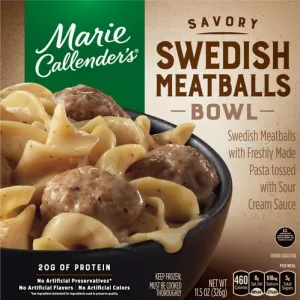
Purchase This Product By Clicking On The Link (USA Only).
[Please note we are an affiliate marketing partner and will make a sales commission if you purchase any items through our affiliate links. Please read our affiliate disclosure]

Leave a Reply