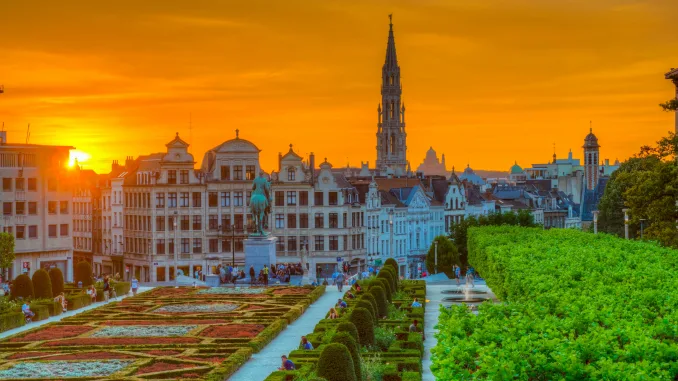
The train from Paris glides into Brussels with a punctual sigh, and as I step onto the platform, the air seems different — heavier, perhaps, with the mingling scent of roasted coffee, melting chocolate, and the faint tang of rain on cobblestones. Belgium announces itself not with monuments or slogans but with aromas. It is a country of quiet corners and deep flavours, where history lives not only in the spires of Bruges or the grand squares of Brussels but in the kitchens and cafés that line its narrow streets. I have come, as travelers often do, with a list of famous things to taste — waffles, beer, chocolate, fries — but what I will find, over the course of a wandering week, is a cuisine that is both humble and grand, a reflection of a people who take their pleasure seriously, yet without pretension.
Belgium’s geography, perched between France, Germany, and the Netherlands, is the key to its kitchen. It is a crossroads, a country both northern and southern, where butter meets beer, where cream meets spice, and where medieval guilds once guarded recipes as fiercely as crown jewels. “We eat like the French and drink like the Germans,” a Brussels café owner tells me on my first night, and though he says it with a laugh, the line rings true. Belgian cooking marries the finesse of French gastronomy with the generosity of Flemish appetite. It is food meant to comfort, not to intimidate.
The Capital’s Table
Brussels, at first glance, feels too formal to be a city of appetites. Its government buildings rise in austere symmetry, its avenues radiate like well-combed hair. Yet step into the side streets of the Marolles district or the warren around the Grand-Place, and the mood shifts. Brass-handled doors swing open onto dim brasseries glowing amber with candlelight. There are wood-paneled walls, chalkboard menus, and the soft clink of forks on porcelain. Every table seems to hold a bowl of steaming moules-frites — mussels cooked in white wine and herbs, served with fries crisp enough to crackle at the touch.
The Belgians, I learn, claim the invention of the fry, and they defend this claim with the fervor of a national myth. The story goes that villagers in the Meuse Valley once fried small fish caught from the river, but when the water froze in winter, they cut potatoes into fish-like strips and fried those instead. Whether or not this is true, the practice has become religion. There are whole institutions — friteries — devoted to the art, their windows fogged with oil and laughter. The fries are cooked twice, first to soften, then to crisp, and served with a dizzying array of sauces: mayonnaise enriched with egg yolk, tart and golden Andalouse, peppery Samouraï. Standing in the drizzle with a paper cone in hand, I find it impossible not to smile.
At Chez Léon, one of Brussels’ oldest seafood houses, I watch a waiter carry a tray of mussels to a table of businessmen who promptly loosen their ties. The pot opens like a treasure chest. Steam spills out scented with shallots and celery; beneath it, plump mussels gleam black and gold. There are fries, of course, and a carafe of white beer — cloudy, perfumed with coriander and orange peel. The waiter tells me it is Witbier, the pale wheat ale that pairs best with seafood. “The beer cleans the palate,” he says, and he is right: the pairing feels inevitable, like the rhyme at the end of a poem.
Chocolate: The National Obsession
If fries are Belgium’s soul food, then chocolate is its heart — dark, rich, and endlessly varied. Nowhere else have I seen such reverence for cacao. In the Galeries Royales Saint-Hubert, the elegant 19th-century arcade in Brussels, the windows of Neuhaus, Godiva, and Pierre Marcolini gleam like jewelry cases. Behind them stand neat rows of pralines, truffles, and ganaches, each a miniature work of architecture. The air is thick with cocoa and cream; even the marble floors seem to exhale sweetness.
It was here, in Brussels, that the filled chocolate — the praline — was invented in 1912 by Jean Neuhaus, a pharmacist who once coated his medicines in chocolate to make them more palatable. His granddaughter’s husband later created the ballotin, the box designed to protect the fragile bonbons, and with that small act of packaging, Belgium began its love affair with chocolate artistry. Today, artisans experiment with flavours that border on alchemy: passion fruit ganache, Earl Grey truffle, basil and lime praline. Yet the classic combination of hazelnut and milk chocolate remains unchallenged.
I spend an afternoon touring a small workshop in Ixelles, where a young chocolatier named Sophie lets me dip a spoon into a vat of melted couverture. “Belgian chocolate,” she explains, “isn’t just about the cocoa bean. It’s about texture — the balance between snap and melt.” She snaps a finished praline between her fingers; the sound is sharp, like the crack of a fine crust. “If it doesn’t make that sound,” she says, “it isn’t right.”
Waffles and Whimsy
There are two kinds of waffles in Belgium, and knowing the difference is a small badge of understanding. The Brussels waffle is light and crisp, served with a snowfall of powdered sugar or sometimes fresh strawberries and cream. The Liège waffle, by contrast, is dense, caramelized, and studded with pearls of sugar that melt into glossy amber pockets as it cooks. Both are eaten with delight and little ceremony, often standing at a street corner or perched on a fountain edge.
In the city of Liège itself, I find a vendor who has been making waffles for thirty years. His iron, blackened with age, gives off the smell of browned butter and vanilla. “Each one takes three minutes,” he tells me, timing the turn with the ease of a musician keeping rhythm. The result is perfection: golden, sticky, warm enough to fog my glasses. I walk through the Sunday market eating slowly, each bite a small act of joy.
The waffle, like so much of Belgian food, balances elegance and indulgence. It can be dressed with whipped cream and berries in a hotel tearoom or eaten plain from a napkin on a cold day. There is no hierarchy, no wrong way — and that democratic spirit runs deep in Belgian cuisine.
Beer: The Alchemy of Monks
If chocolate is Belgium’s sweetest legacy, beer is its most sacred. There are more than 1,500 distinct varieties brewed within this small country — a staggering number for a land barely the size of Maryland. The tradition dates back to the Middle Ages, when monasteries brewed ale both as sustenance and as a source of income. Today, the Trappist beers remain the most revered, still brewed within abbey walls under the supervision of monks, their proceeds devoted to charity.
At the Abbaye Notre-Dame de Scourmont in Chimay, the birthplace of the famous blue-label beer, I sit in a quiet tasting room overlooking rolling fields. The beer arrives in a chalice rather than a glass, its head thick and creamy. The flavour is astonishing: dark fruit, caramel, spice, and a lingering note of clove. It is less a drink than an experience, complex as wine yet comforting as bread.
Every region has its own specialty. In Flanders, the sour Oud Bruin and Lambic beers are prized, aged in oak barrels and blended for balance. In Wallonia, the pale, dry Saison ales refresh farmworkers and city dwellers alike. There are fruity Krieks brewed with cherries, smoky ales from East Flanders, and amber Dubbel and Tripel styles that defy simple description.
One night in Bruges, I join a group of locals at ’t Brugs Beertje, a beloved beer café where the menu reads like an encyclopedia. The owner recommends a Westvleteren 12, whispering that it is the rarest of all. I sip it reverently, feeling the warmth of the alcohol bloom slow and deep. Around me, strangers talk softly, as if in church. Here, beer is not for drunkenness but for reflection — a liquid link to history, landscape, and craft.
The Coastal Table: From Sea to Plate
On the Belgian coast, the cuisine changes with the tides. In Ostend, a salty breeze carries the promise of seafood — shrimp, sole, and grey prawns so tiny they might vanish if you looked away. The city’s fish market, the Vistrap, opens at dawn; fishermen in rubber boots unload crates of glistening catch, and by noon, the same shrimp appear in croquettes at seaside cafés.
I try croquettes aux crevettes grises, golden cylinders filled with a creamy mixture of béchamel and minced North Sea shrimp. The exterior crackles under the fork, the filling sighs into richness. With a squeeze of lemon, it tastes of both sea and comfort. Nearby, a family shares a platter of sole meunière, the fish browned in butter until the air itself smells nutty. It is simple food, made transcendent by freshness.
In the dunes beyond the city, chefs have begun to rediscover wild herbs and coastal plants — samphire, sea aster, dune spinach — weaving them into modern menus that bridge land and sea. At a small restaurant in De Haan, I taste a dish of cod with samphire and brown butter that feels almost poetic: a hymn to brine and restraint. Belgian cooking, I realize, is often about memory — not nostalgia, but continuity.
Flanders: Hearty and Honest
Travel north and the tone shifts again. In Ghent and Bruges, the influence of medieval trade and guild culture is still palpable. Here, the food is sturdier, more rustic, built for the climate of fog and rain. The signature dish is stoofvlees, a beef stew simmered in beer until the meat collapses into tenderness. The sauce is dark, sweetened with brown sugar and mustard, served with fries or mashed potatoes. Each household guards its own recipe — some add bread to thicken it, others a splash of vinegar for brightness.
At a tavern in Ghent called Het Waterhuis aan de Bierkant, I sit by the canal watching ducks glide past and eat stoofvlees spooned over fries. The beer used, the waiter tells me, is often a local brown ale — something malty, not too bitter. The result is comfort incarnate: the warmth of the stew against the damp chill of the evening.
Flanders also gives the world carbonnade flamande, Gentse waterzooi, and a devotion to root vegetables that could fill a still life. Waterzooi, a creamy soup of chicken or fish with leeks, carrots, and potatoes, was once food for the poor, but today it appears on fine-dining menus, its humble origins preserved only in its soothing simplicity. The name means “boil water,” but the result is anything but plain.
In Bruges, I dine at a restaurant where the chef reinterprets the classics with modern grace — rabbit stewed with prunes presented like an art installation, parsnip purée swirled like brushstrokes. Yet the flavours remain true: sweet, savory, faintly spiced. It is this balance between innovation and authenticity that defines Belgian gastronomy today.
Wallonia: Forests and Fireplaces
South of Brussels, the rolling hills of Wallonia offer a different kind of feast. Here the forests provide game — wild boar, pheasant, venison — and the tables groan under the weight of autumnal flavours. The air smells of woodsmoke and mushrooms; the pace slows. In Namur, I eat a dish of wild duck with cherries, paired with a glass of Côte de Sambre et Meuse red wine. The sauce is rich and faintly sweet, the duck smoky from the grill. “This,” says my host, “is the taste of the Ardennes.”
In the small town of Durbuy, which claims to be the smallest city in the world, I wander cobbled streets lined with stone houses and find a restaurant no bigger than a living room. The menu changes daily: that night it is rabbit with mustard sauce and a dessert of tarte au sucre — sugar tart — baked to a caramel crisp. The owner, a grandmotherly woman named Hélène, tells me she still uses her mother’s recipes. “Belgian cooking,” she says, “is about patience. You cannot rush flavour.”
Cheese, too, plays a central role here. From the creamy Herve, pungent and powerful, to the delicate Chimay à la bière, washed in ale from the local abbey, Belgian cheeses mirror their landscapes: soft and lush in the lowlands, sharp and earthy in the hills. I visit a small dairy near Herve where wheels age on wooden racks, their rinds brushed with brine. The farmer cuts me a slice, and it smells faintly of apples and hay. Paired with a Trappist beer, it feels like tasting the countryside itself.
The Modern Renaissance
It would be easy to imagine Belgian cuisine frozen in time — all stews, fries, and chocolates — but that would be a mistake. In recent years, a new generation of chefs has reimagined the country’s traditions with quiet brilliance. They call their movement bistronomy: the blending of bistro warmth with gastronomic creativity.
In Brussels, I visit Kamo, the city’s only Michelin-starred Japanese restaurant, where chef Kamo Tomoyasu marries Belgian ingredients with Japanese technique — North Sea fish with dashi, Ardennes mushrooms with soy. Nearby, at Bozar Brasserie, chef Karen Torosyan turns puff pastry into sculpture, creating intricate pâté en croûte that pay homage to both French heritage and Belgian artistry.
In Antwerp, the dining scene hums with energy. The port city has always been cosmopolitan, and its kitchens reflect that. At The Jane, a converted chapel with stained-glass windows, diners eat under a vaulted ceiling while DJs spin soft electronic beats. The dishes arrive like artworks — langoustine with citrus gel, pigeon with beetroot dust — but the flavours, at their core, remain distinctly Belgian: rooted in produce, anchored by butter, elevated by restraint.
The farm-to-table movement, too, has found fertile ground here. In Flanders, small organic farms supply restaurants with heirloom vegetables, while along the coast, fishermen practice sustainable harvesting of grey shrimp and mussels. The old and new coexist, as they always have in Belgium — a country too small for excess but too proud for compromise.
The Café as Living Room
Perhaps the truest expression of Belgian food culture lies not in the starred restaurants but in its cafés. These are not mere coffee houses but social institutions, half living room, half public square. In Brussels’ Café Belga, students and politicians share tables over tartines and local beer. In Bruges, lace-curtained cafés serve croque monsieur sandwiches and tartlets filled with apricots.
Everywhere, there is warmth — literal and metaphorical. The Belgians have a word, gezellig, which the Dutch also use: it means cozy, convivial, the feeling of belonging. A café is gezellig when the light is low, the company easy, and the food simple but satisfying. One might order stoemp, mashed potatoes mixed with vegetables, topped with sausage; or vol-au-vent, puff pastry filled with chicken and mushrooms in cream. Nothing fancy, yet everything just right.
Festivals of flavour
Food in Belgium is woven into the calendar. Each town seems to have its own festival celebrating what it does best: chocolate in Bruges, beer in Leuven, shrimp in Oostduinkerke. The shrimp festival there is particularly curious — fishermen in yellow slickers ride horses into the surf, dragging nets behind them as in centuries past. They return triumphant, their baskets brimming with grey shrimp, which are cooked and eaten on the beach. Children laugh, old men drink beer, and the air smells of salt and pride.
In Binche, during the carnival, revelers throw oranges from balconies while feasting on waffles and beer. In Ghent, the ten-day Gentse Feesten fills the streets with music and the aroma of grilled sausage. Food here is not an accessory to celebration; it is the celebration itself.
A Conversation with the Past
By the time my journey nears its end, I have come to see Belgian cuisine as a conversation — between past and present, between regions and languages, between simplicity and sophistication. It is a cuisine built not on extravagance but on care: the slow stirring of stew, the precise tempering of chocolate, the patient double-frying of potatoes.
At a café in Leuven on my final night, I order stoemp-saucisse and a glass of amber ale. Outside, rain streaks the windows, and bicycles glisten under the streetlights. The waitress brings my plate with a smile that seems to say, You’re one of us now. The sausage is coarse, the potatoes buttery, the beer perfectly chilled. Around me, people talk softly in Flemish and French, the languages mingling like flavours in a stew.
Belgium, I realize, is a country that hides its treasures in plain sight. Its food does not shout; it whispers, inviting you to lean closer, to taste carefully, to notice. The magic lies in its modesty — in the way a plate of fries can carry centuries of pride, or a square of chocolate can embody craftsmanship passed down through generations.
When I leave the next morning, the city still smells faintly of coffee and butter. At the station café, I buy a pain au chocolat and a small paper cone of fries, unable to resist one last indulgence. Outside, trains hum like distant memories. I take a bite — crisp, warm, familiar — and smile.
In Belgium, every meal feels like a homecoming.
Article written by Angela Holder for FoodWrite Ltd


Leave a Reply