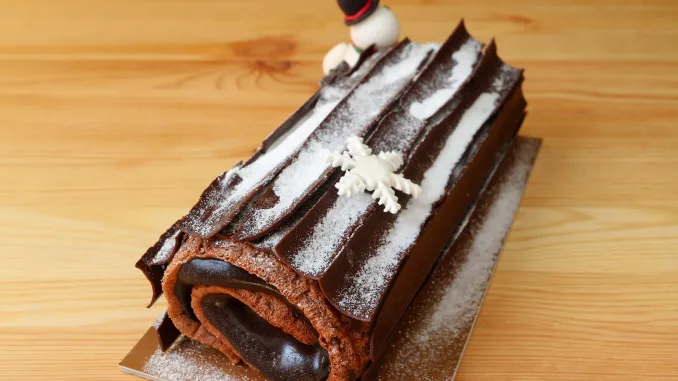
The chocolate yule log, known in France as the bûche de Noël, is the edible descendant of a much older ritual that once involved fire rather than sugar. Its story begins in pre-Christian Europe, where communities marked the winter solstice by burning a massive log in the hearth. The log, often selected with ceremony, was meant to burn slowly through the longest night of the year, its flames symbolizing the sun’s return and its ashes believed to protect the household and ensure fertility in the year to come. This was a practical ritual as much as a symbolic one, binding warmth, survival, and hope into a single object.
As Christianity spread across Europe, the solstice custom was absorbed into Christmas celebrations. The yule log remained central to family life, especially in rural areas, where it was lit on Christmas Eve and sometimes kept smoldering for days. In France, the tradition took on particular resonance; different regions developed their own rules for how the log was chosen, blessed, and burned. By the nineteenth century, however, the practice was in decline. Large hearths were disappearing from urban homes, replaced by smaller stoves and modern heating. The symbolic center of Christmas needed a new form.
That transformation occurred in French pastry kitchens in the late nineteenth century, when bakers began reimagining the yule log as a dessert rather than a piece of timber. Rolled sponge cake, filled with cream and coated in chocolate buttercream, proved ideal. It could be shaped to resemble bark, dusted with powdered sugar like snow, and adorned with meringue mushrooms, holly leaves, or spun sugar. Chocolate, still a relative luxury at the time, added a sense of indulgence appropriate to a once-a-year celebration.
The chocolate yule log preserved the meaning of the original ritual while translating it into a form suited to modern life. The hearth became the table, the fire became flavor, and the shared act of tending a log through the night became the shared act of slicing and serving a cake. In this way, the bûche de Noël is not merely decorative nostalgia but a cultural adaptation, carrying forward the idea that light and sweetness can be summoned, even in the darkest part of the year, by gathering together and honoring tradition in whatever form the present allows.
Equipment
(Click on the links to be connected to our affiliate marketing partners)
Making a yuletide log is technically straightforward but equipment-sensitive. The goal is a thin, flexible sponge that rolls cleanly, paired with a stable filling and a convincingly textured exterior. The core tools break down as follows.
You need a rimmed baking sheet or jelly roll pan, typically around 10 by 15 inches. The rim matters because the sponge batter is thin and must be spread evenly without spilling. Line it with parchment paper, cut to fit precisely, to prevent sticking and to aid in lifting and rolling the cake while warm.
A stand mixer or hand mixer is strongly recommended. The sponge relies on well-aerated eggs rather than chemical leavening, so the ability to whip eggs and sugar to proper volume is non-negotiable. You will also need mixing bowls of varying sizes, ideally one large bowl for whipping and a smaller one for folding dry ingredients.
For shaping, a rubber spatula is essential for folding the batter gently and scraping it evenly across the pan. An offset spatula helps spread both the batter and the buttercream cleanly and thinly. To ensure even baking, keep a small palette knife or bench scraper on hand for final surface leveling, though this is optional.
Rolling the cake requires a clean kitchen towel or additional parchment paper, lightly dusted with cocoa powder or powdered sugar. This prevents sticking and allows the sponge to be rolled while still warm, which sets its shape without cracking.
Once baked, assembly and finishing call for a serrated knife for trimming edges and cutting branch-like sections, and a fork or textured scraper to score the buttercream so it resembles tree bark. A pastry brush is useful if you plan to apply a soaking syrup to keep the sponge moist.
Finally, basic measurement and temperature control matter. A digital kitchen scale improves consistency, especially for sponge cakes, and an oven thermometer is helpful if your oven runs unevenly. None of this equipment is exotic, but each piece supports precision, which is what turns a simple rolled cake into a convincing and elegant yule log.
Ingredients:
For the cake
- 3 eggs
- 85g golden caster sugar
- 85g plain flour (minus 2 tbsp)
- 2 tbsp cocoa powder
- ½ tsp baking powder
For the filling & icing
- 50g butter, plus extra for the tin
- 140g dark chocolate, broken into squares
- 1 tbsp golden syrup
- 284ml pot double cream
- 200g icing sugar, sifted
- 2-3 extra strong mints, crushed (optional)
- icing sugar and holly sprigs to decorate – ensure you remove the berries before serving
Preparation:
- Heat the oven to 200C/180C fan/gas 6. Butter and line a 23 x 32cm Swiss roll tin with baking parchment. Beat the eggs and golden caster sugar together with an electric whisk for about 8 mins until thick and creamy.
- Mix the flour, cocoa powder and baking powder together, then sift onto the egg mixture. Fold in very carefully, then pour into the tin. Tip the tin from side to side to spread the mixture into the corners. Bake for 10 mins.
- Lay a sheet of baking parchment on a work surface. When the cake is ready, tip it onto the parchment, peel off the lining paper, then roll the cake up from its longest edge with the paper inside. Leave to cool.
- To make the icing, melt the butter and dark chocolate together in a bowl over a pan of hot water. Take from the heat and stir in the golden syrup and 5 tbsp double cream. Beat in the icing sugar until smooth.
- Whisk the remaining double cream until it holds its shape. Unravel the cake, spread the cream over the top, scatter over the crushed extra strong mints, if using, then carefully roll up again into a log.
- Cut a thick diagonal slice from one end of the log. Lift the log on to a plate, then arrange the slice on the side with the diagonal cut against the cake to make a branch. Spread the icing over the log and branch (don’t cover the ends), then use a fork to mark the icing to give the effect of tree bark. Scatter with unsifted icing sugar to resemble snow, and decorate with holly.

Leave a Reply