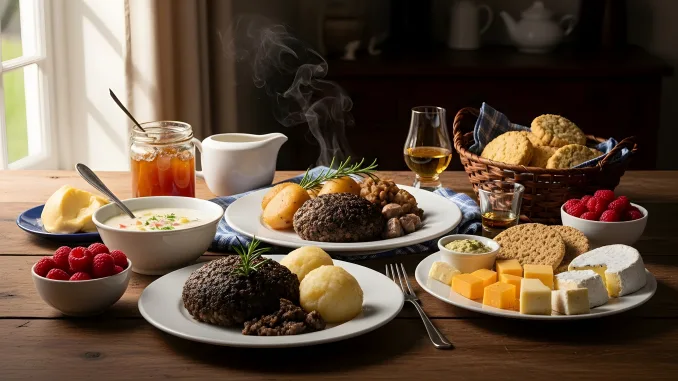
Burns Night is a supper rather than a feast, domestic in spirit even when it is ceremonial, and what is eaten is as important for its associations as for its flavours. The meal is built around haggis, that most Scottish of dishes, which arrives not apologetically but with a certain deliberate grandeur. It is a robust pudding, peppery and warm with spice, made from sheep’s offal finely chopped with onions and oatmeal, bound together and cooked slowly until it becomes something far greater than its plain ingredients suggest. One eats it not analytically but with gratitude, for its honesty and its sustaining quality, and because it belongs so completely to its place.
With the haggis come the inevitable companions: neeps and tatties. The neeps—turnips, or more properly swedes—are mashed to a soft, faintly sweet purée, their bitterness tamed by butter and a little salt. The tatties are potatoes, floury and unpretentious, mashed or sometimes simply boiled, there to absorb the savoury richness of the haggis and to provide a necessary calm on the plate. Together they make a combination that is not elegant in the modern sense, but deeply satisfying, the sort of food that makes sense in a cold climate and a long evening.
Whisky, of course, is present, not merely as a drink but as a punctuation mark. It is taken with the haggis, poured carefully, raised solemnly, and sipped with respect rather than thirst. Its smokiness and warmth seem to sharpen the appetite and at the same time slow it, encouraging conversation and reflection, which is after all the true object of the evening.
Afterwards there may be something sweet, though this is rarely the point of the meal. Cranachan is the most fitting: cream lightly whipped, oats toasted until they smell faintly nutty, a spoonful of honey, perhaps a scattering of raspberries if they are in season or remembered from summer. It is a gentle ending, not heavy, and it carries with it the sense of thrift and pleasure that runs through Scottish cooking at its best.
What is eaten on Burns Night is not elaborate, nor is it meant to be. It is food that speaks of landscape and weather, of frugality made generous, and of tradition kept alive not in museums but at the table, with people gathered close, listening, eating, and raising a glass.
Related Posts
 Sauce Robert (Brown Mustard Sauce)
One of the oldest sauces know in the canon of French sauce cookery is the…
 No Links Between Child Obesity And Eating Late-Night Dinners
♦ A recent study finds no reason to believe that children who eat later than…
 Expect Health Problems And Weight Gain If You Eat Late At Night
You come back from an evening's socialising, from some event or you are just late…
 Celebrating Hogmanay
Here's an exploration of what people eat at Hogmanay, Scotland's famous New Year celebration. I'll…
Leave a Reply