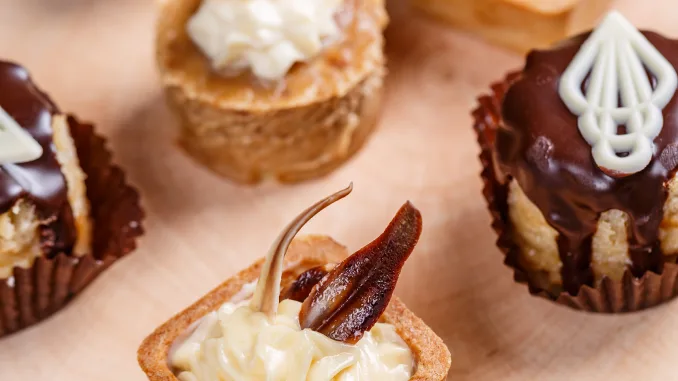
Petit fours are small, refined confections traditionally served at the end of a meal or alongside tea, designed to be consumed in one or two bites. The term derives from the French “petits fours,” literally “small ovens,” a reference to the residual heat of bread ovens used in pre-industrial France. After the main baking was finished and the oven temperature declined, pastry cooks would utilize the gentler heat to bake delicate items requiring precise, moderate temperatures. Over time, the phrase evolved from a practical descriptor of oven management into a culinary category encompassing a range of miniature pastries, cakes, and sweets characterized by precision, elegance, and balance. Nowadays they are something special to have with a coffee after a fine meal.
Classically, petit fours are divided into several categories, each reflecting distinct techniques and textures. The most widely recognized are “petits fours glacés,” which are small iced or glazed cakes. These typically begin with a thin sheet of génoise or sponge cake baked in shallow pans, cooled, and layered with buttercream, jam, ganache, or marzipan. The layered slab is chilled to stabilize the filling, then cut into precise geometric shapes—most often squares or rectangles. Each piece is coated in poured fondant, a glossy sugar glaze that sets into a smooth, opaque shell. The glaze may be tinted in pastel hues, and the finished cakes are decorated with fine piping, candied violets, or slivers of fruit. The visual effect is architectural: clean edges, uniform height, and a mirrorlike finish.
Another principal category is “petits fours secs,” literally “dry small ovens.” These are crisp, dry confections such as sablés, palmiers, macarons, langues de chat, and miniature meringues. Unlike the glacés, they rely on low moisture content for shelf stability and texture. Petits fours secs are typically piped or cut into delicate shapes and baked to precise coloration, emphasizing clean lines and consistent size. Because they are served as part of an assortment, visual contrast—shape, color, and garnish—is as important as flavour differentiation. The goal is variety without redundancy: perhaps a chocolate-dipped almond sablé beside a pistachio macaron and a hazelnut meringue, each offering a distinct textural and aromatic experience.
A third, more festive grouping includes “petits fours frais,” or fresh petit fours. These are perishable items such as miniature éclairs, tartlets, choux puffs, and fruit-topped custard bites. Their high moisture fillings—pastry cream, whipped cream, fresh fruit—limit storage time and require careful refrigeration. In professional pastry kitchens, production scheduling for petits fours frais is tightly controlled to ensure optimal texture and food safety at service.
The technical execution of petit fours demands advanced pastry skills, particularly in scaling, knife work, glazing, and decoration. Uniformity is paramount; each piece in a tray must be identical in dimension and finish. For glacés, the geometry of the cut is critical. Pastry chefs use long, heated knives to achieve sharp edges without compressing the crumb. The poured fondant must be at a precise temperature—warm enough to flow smoothly, but not so hot that it melts the underlying buttercream or slides off the cake. Achieving a seamless coating without drips requires practiced hand movement and correct viscosity.
Flavour architecture in petit fours is restrained yet intentional. Because of their small size, flavours must be concentrated and balanced. A typical glacé might pair almond sponge with apricot preserve and kirsch buttercream, the acidity of the fruit offsetting the sweetness of fondant. Chocolate-based versions often rely on ganache for depth, sometimes accented with coffee or orange zest. Excessive sweetness is a common pitfall; skilled pâtissiers temper sugar levels with salt, acidity, or bitterness to maintain sophistication.
The historical roots of petit fours lie firmly in the development of French haute pâtisserie. During the 18th and 19th centuries, as culinary guilds flourished in cities such as Paris, pastry chefs refined techniques for sponge cakes, sugar work, and decorative piping. The formalization of service “à la russe,” in which courses were served sequentially rather than placed all at once on the table, created a structured conclusion to meals. Petit fours became a refined accompaniment to coffee or tea, signaling hospitality and craftsmanship. Influential culinary authorities such as Marie-Antoine Carême codified many foundational pastry techniques, emphasizing precision and visual harmony that would later define petit fours presentation.
By the late 19th and early 20th centuries, luxury hotels and grand restaurants across Europe adopted the practice of presenting assortments of petit fours at the end of elaborate dinners. In the era of The Ritz Paris and similar establishments, these confections reinforced an image of refinement and abundance. As French culinary influence spread globally, petit fours became staples of formal receptions, afternoon teas, and wedding celebrations. Their miniature scale made them adaptable to buffet-style service and social gatherings, where guests could sample multiple flavours without committing to a full slice of cake.
In the Anglophone world, the term “petit four” often refers specifically to the iced, layered variety, particularly those coated in pastel fondant. In Britain, they are closely associated with afternoon tea traditions influenced by French pastry techniques. In the United States, mid-20th-century cookbooks popularized simplified versions made from pound cake cut into cubes and dipped in confectioners’ glaze. While these home adaptations lack some of the refinement of professional pâtisserie, they demonstrate the versatility of the concept.
From a production standpoint, petit fours occupy a unique niche in pastry operations. They require meticulous labor but yield high perceived value. Because each piece is small, ingredient cost per unit is modest, yet the labor intensity—especially in glazing and decoration—demands skilled hands. In contemporary fine dining, petit fours are sometimes reimagined as “mignardises,” a term emphasizing delicacy. Restaurants may present them on bespoke trays, slate boards, or tiered stands, incorporating modernist elements such as fruit gels or chocolate spheres while retaining the miniature format.
Texture is a defining characteristic across categories. In glacés, the contrast between tender sponge, creamy filling, and thin sugar shell creates layered sensory experience. In secs, crispness is paramount; humidity control is essential to prevent staling. For frais, freshness and lightness dominate, with emphasis on delicate choux or flaky pâte sucrée shells. The scale magnifies flaws: a slightly dry sponge or uneven glaze is immediately perceptible.
Contemporary pastry chefs continue to innovate within the framework of petit fours. flavour profiles may incorporate global influences—matcha, yuzu, passion fruit, cardamom—while maintaining classical technique. Advances in silicone molds, tempered chocolate decoration, and precise temperature-controlled ovens have improved consistency. Yet the underlying principles remain anchored in French pâtisserie: proportion, balance, and elegance.
Culturally, petit fours symbolize attentiveness. To serve them is to offer guests not merely sustenance but a curated sensory finale. Their small size encourages conversation and sampling, reinforcing sociability. They also represent a democratization of luxury: even modest gatherings can feature miniature confections that evoke grand dining traditions.
In essence, petit fours are less a single recipe than a philosophy of scale and refinement. Born from the practical management of oven heat, they evolved into emblems of culinary precision and aesthetic restraint. Whether glazed in pastel fondant, baked crisp and dry, or filled with fresh cream and fruit, they distill the craft of pastry into concentrated form. Through disciplined technique and careful flavour composition, these small confections achieve a disproportionate impact, closing meals with nuance, texture, and visual grace.
Leave a Reply