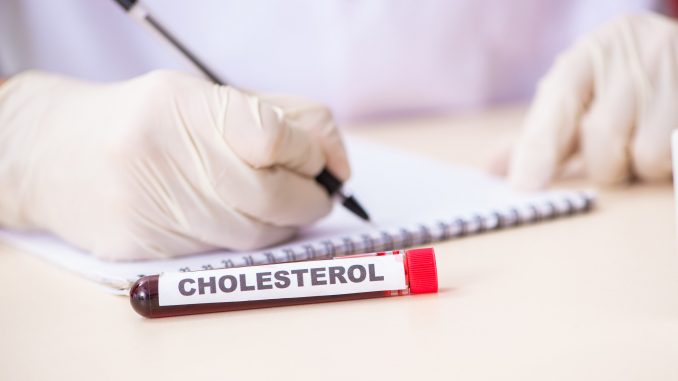
Cholesterol is a waxy, fat-like substance that your body uses to build and maintain cells, make certain hormones, produce vitamin D, and create bile acids that help digest fats.
It’s a type of lipid (fat), but unlike triglycerides (which are mainly an energy source), cholesterol is more of a structural and functional building block.
Key Points About Cholesterol
1. Where it comes from
-
Endogenous (made by the body) — Your liver makes about 70–80% of your cholesterol.
-
Exogenous (from food) — Found in animal-based foods such as meat, eggs, and dairy.
2. Role in the body
-
Cell membranes — Cholesterol makes them fluid but stable.
-
Hormones — Precursor for steroid hormones (cortisol, estrogen, testosterone).
-
Vitamin D synthesis — Made in skin from cholesterol with help of sunlight.
-
Bile acids — Produced in the liver from cholesterol to digest fats.
3. Transport in the blood
Cholesterol can’t dissolve in water, so it travels in the bloodstream in lipoproteins:
-
LDL (low-density lipoprotein) — “Bad cholesterol”; delivers cholesterol to cells, but high levels can deposit it in artery walls.
-
HDL (high-density lipoprotein) — “Good cholesterol”; carries cholesterol back to the liver for disposal.
-
VLDL, IDL — Other lipoprotein forms involved in triglyceride and cholesterol transport.
4. Why too much can be harmful
Excess LDL cholesterol can build up in blood vessel walls → forms plaques → leads to atherosclerosis → increases risk of heart attack and stroke.
5. Why too little is also a problem
Cholesterol is essential — extremely low levels can interfere with hormone production, cell structure, and brain function.
Further Knowledge About Cholesterol
1. What We Mean by “Types of Cholesterol”
When people talk about “types of cholesterol,” they often mean the types of lipoproteins that carry cholesterol in the blood, rather than different chemical species of cholesterol.
Chemically, cholesterol is one molecule (C₂₇H₄₆O) — but in the body, it exists in different forms and transport packages:
-
Free (unesterified) cholesterol – present in cell membranes and lipoprotein surfaces.
-
Cholesteryl esters – storage form, where a fatty acid is attached to cholesterol.
-
Lipoprotein-associated cholesterol – cholesterol carried inside various lipoproteins:
-
Chylomicrons
-
VLDL (very-low-density lipoprotein)
-
IDL (intermediate-density lipoprotein)
-
LDL (low-density lipoprotein — “bad cholesterol”)
-
HDL (high-density lipoprotein — “good cholesterol”)
-
2. Where Cholesterol Comes From
A. Endogenous production (synthesized by the body)
-
Your body makes ~70–80% of its cholesterol — primarily in the liver, intestines, adrenal glands, and reproductive organs.
-
This happens through the mevalonate pathway, starting from acetyl-CoA (a breakdown product of fats and carbohydrates).
-
The rate-limiting step is the enzyme HMG-CoA reductase — the same enzyme targeted by statin drugs.
B. Exogenous intake (from diet)
-
The rest comes from animal-based foods (meat, eggs, dairy, fish).
-
Dietary cholesterol is absorbed in the small intestine with help from bile salts.
-
It’s then packaged into chylomicrons for transport in the lymphatic system and bloodstream.
3. The Forms of Cholesterol in the Body
Let’s go through them systematically.
1. Free (Unesterified) Cholesterol
-
Where found: Cell membranes, lipoprotein surfaces.
-
Structure: Just the cholesterol molecule itself, with a hydroxyl (-OH) group.
-
Function: Maintains membrane fluidity and integrity; serves as precursor for steroid hormones and bile acids.
-
Formation: Made in the ER of cells, then inserted into membranes; also obtained from dietary absorption.
2. Cholesteryl Esters
-
Where found: Inside lipoprotein cores, inside cells (storage).
-
Structure: Cholesterol with its hydroxyl group esterified to a fatty acid (usually long-chain).
-
Function: Storage and transport form; less polar than free cholesterol, so it’s packed into lipoprotein cores.
-
Formation:
-
In the bloodstream: By LCAT (lecithin–cholesterol acyltransferase) — activated by apoA-I in HDL.
-
In cells: By ACAT (acyl-CoA–cholesterol acyltransferase).
-
4. Lipoprotein Types Carrying Cholesterol
These are the “vehicles” that move cholesterol and other lipids through the watery blood.
A. Chylomicrons
-
Main role: Carry dietary triglycerides and cholesterol from the intestines to tissues.
-
Formation:
-
After a fat-containing meal, dietary fats and cholesterol are absorbed by intestinal cells (enterocytes).
-
Inside enterocytes, cholesterol is esterified and packaged with triglycerides, phospholipids, and apolipoproteins (mainly apoB-48).
-
These form nascent chylomicrons → enter the lymphatic system → bloodstream.
-
-
Fate:
-
Triglycerides are removed by lipoprotein lipase (LPL) in muscle and adipose tissue.
-
Remnants (rich in cholesterol) are taken up by the liver.
-
B. VLDL (Very-Low-Density Lipoprotein)
-
Main role: Carry triglycerides and cholesterol from the liver to peripheral tissues.
-
Formation:
-
Liver synthesizes triglycerides and cholesterol.
-
These are packaged with apoB-100 into nascent VLDL.
-
Secreted into blood, where they acquire apoC-II and apoE from HDL.
-
-
Fate:
-
LPL removes triglycerides → VLDL becomes IDL (more cholesterol-rich).
-
C. IDL (Intermediate-Density Lipoprotein)
-
Main role: Transitional particle between VLDL and LDL.
-
Formation: VLDL remnants after triglyceride removal.
-
Fate:
-
Taken up directly by the liver (via apoE recognition).
-
Or further metabolized into LDL.
-
D. LDL (Low-Density Lipoprotein) — “Bad Cholesterol”
-
Main role: Deliver cholesterol to cells for membrane synthesis, hormone production, etc.
-
Formation: From IDL after more triglyceride removal by hepatic lipase.
-
Why “bad”:
-
High levels → cholesterol deposits in artery walls → atherosclerosis.
-
-
Uptake:
-
Via LDL receptors (recognizing apoB-100).
-
Uncontrolled uptake by macrophages → foam cell formation → plaques.
-
E. HDL (High-Density Lipoprotein) — “Good Cholesterol”
-
Main role: Reverse cholesterol transport — carry cholesterol away from tissues/arteries to the liver.
-
Formation:
-
Liver and intestine secrete nascent HDL (discoidal shape) containing apoA-I.
-
HDL picks up free cholesterol from cells (via ABCA1 transporter).
-
LCAT esterifies cholesterol, moving it to HDL’s core → mature spherical HDL.
-
-
Fate:
-
Delivers cholesterol to liver (via SR-B1 receptor) for excretion into bile.
-
Transfers cholesteryl esters to VLDL/LDL in exchange for triglycerides (via CETP).
-
5. Synthesis and Regulation of Cholesterol
A. Biosynthesis steps (simplified)
-
Acetyl-CoA → HMG-CoA (by thiolase and HMG-CoA synthase)
-
HMG-CoA → Mevalonate (by HMG-CoA reductase, rate-limiting step)
-
Mevalonate → Isoprenoid units → Squalene
-
Squalene → Lanosterol → Cholesterol
B. Regulation
-
Feedback inhibition: High cholesterol suppresses HMG-CoA reductase.
-
Hormonal control:
-
Insulin → ↑ cholesterol synthesis
-
Glucagon → ↓ synthesis
-
-
Drug inhibition: Statins block HMG-CoA reductase.
6. Excretion and Conversion
-
Cholesterol is not degraded into CO₂ and H₂O like many molecules.
-
Eliminated mainly by:
-
Conversion into bile acids (cholic acid, chenodeoxycholic acid)
-
Secretion into bile and excretion in feces
-
-
Some is converted to steroid hormones (cortisol, aldosterone, estrogen, testosterone).
7. Why the Different Types Matter Clinically
High LDL
-
Increases risk of atherosclerosis, heart attack, stroke.
-
Often targeted by diet, exercise, and statins.
Low HDL
-
Reduces ability to remove cholesterol from arteries.
-
Linked to higher cardiovascular risk.
High triglyceride-rich lipoproteins (chylomicrons, VLDL)
-
Associated with pancreatitis and atherogenesis.
8. Summary Table of Lipoprotein Pathway
| Lipoprotein | Origin | Main Cargo | Main Apo-proteins | Primary Role | Final Fate |
|---|---|---|---|---|---|
| Chylomicron | Intestine | Dietary TG & cholesterol | B-48, C-II, E | Deliver dietary TG to tissues | Remnants to liver |
| VLDL | Liver | TG & cholesterol | B-100, C-II, E | Deliver liver TG to tissues | → IDL |
| IDL | VLDL remnant | Cholesterol > TG | B-100, E | Transitional form | → LDL or liver uptake |
| LDL | IDL remnant | Cholesterol | B-100 | Deliver cholesterol to cells | Receptor-mediated uptake |
| HDL | Liver/intestine | Cholesterol (from tissues) | A-I | Reverse cholesterol transport | To liver |
9. Key Takeaways
-
Cholesterol is one molecule, but it travels in different lipoprotein forms.
-
The “good” or “bad” labels refer to the carrier, not the cholesterol itself.
-
The body tightly regulates cholesterol levels via synthesis, dietary absorption, and excretion.
-
Imbalances in production, transport, or clearance → cardiovascular disease.
-
Disorders like Niemann-Pick type C are not about diet-induced high cholesterol but about defects in intracellular cholesterol transport.

Leave a Reply