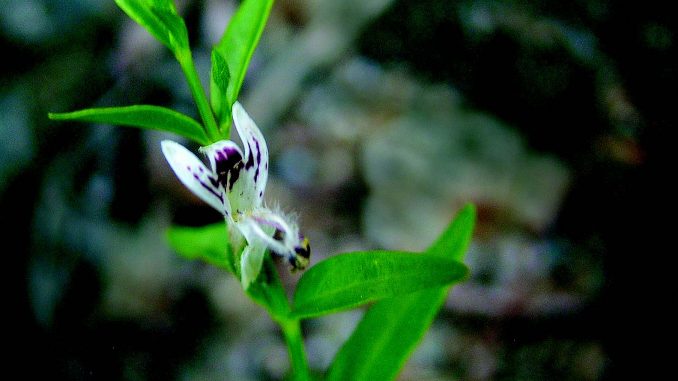
Andrographis paniculata (Burm. f.) Nees (Family: Acanthaceae) or ‘King of Bitters’ produces an extract which has immunostimulant activity and is widely found in Indian (Ayurvedic) and Chinese traditional medicine. It is extremely well-known for being used in the relief of symptoms associated with mild upper respiratory tract infections such as colds. Many countries call it as kariyat, kalmegha, hempedu bumi and polok cerita.
The plant is an upright annual growing to at least 70cm height with a number of branches.
Treatments
The leaves and aerial parts been used for many years to treat liver problems, bowel complaints, sore throats (Melchior et al., 1996), laryngitis (Poolsup et al., 2004), colds, rheumatoid arthritis, colic and fevers within the Chinese and Indian herbal systems.
It is currently being examined for reducing clotting times as part of a treatment for cardiovascular disease (Zhang and Tan, 1997; Guo et al., 1995;1996).
A recent clinical trial showed that an A. paniculata-based treatment relieved the symptoms of rheumatoid arthritis (Burgos et al., 2009)
Dichloromethane extracts of Andrographis paniculata inhibit the proliferation of colon cancer cells (HT-29 cell lines) and promote growth of human peripheral blood lymphocytes (Kumar et al., 2004). Whilst it does not cause actual cancer cell death it would seem to slow down the growth of these cell lines.
Componentry
The main actives include the labdane diterpenes, andrographolide and neoandrographolide although another 18 are known along with a number of other agents with potent immunostimulant activity (Puri et al., 1993). Kumar et al., (2004) found as well as andrographolide, two others called, 14-deoxyandrographolide and 14-deoxy-11,12-didehydroandrographolide. A more complete survey was conducted by Chao and Lin (2010).
There is renewed interest in the inhibition of glucosidase enzymes by some of the Andrographis extracts which are implicated in diabetes (Benalla et al., 2010).
Andrographolide (ANDRO) is also a cytotoxic agent and has significant activity against various cancer cell lines. It appears to help other drugs in their anti-tumour/cancer activity such as gemcitabine in the inhibition and apoptosis (cell death) of pancreatic cancer cells. There is some promising clinical data to support ANDRO’s use with this particular cancer (Bao et al., 2013). It also appears to upset liver cell cancer growth (Ji et al., 2015).
The pharmacological properties of extracts from this plant are reviewed extensively (Jarukamjorn and Nemoto, 2008; Varma et al., 2009; Akbar, 2011).
The Regulatory Situation For Andrographis Extracts
The regulatory situation for Andrographis (Andrographis paniculata) extracts is a good example of how herbal substances can sit in a grey zone between foods, supplements, and medicines. The key point is that there is no single global framework—regulation depends heavily on jurisdiction, intended use, and claims.
– The Specific Situation for Andrographis In The European Union, USA And Australia
In The European Union:-
- There is no adopted EU herbal monograph for Andrographis by the European Medicines Agency (EMA)
- It is not well established as a registered traditional herbal medicine in the EU system
- It is not covered by an official EU pharmacopoeial monograph, which complicates standardisation and approval
As a practical consequence:
- Most Andrographis products in the UK/EU are sold as food supplements, not licensed medicines
- They cannot legally make strong therapeutic claims (e.g. “treats infections”)
In The USA:-
In the US, Andrographis extracts fall under the dietary supplement category regulated by the FDA:
- No pre-market approval required for safety/efficacy
- Manufacturers must follow Good Manufacturing Practice (cGMP)
- Products cannot claim to diagnose, treat, or cure disease
- If a company markets Andrographis with drug-like claims, the FDA can reclassify it as a drug and take enforcement action.
In Australia:
Australia treats Andrographis as a complementary medicine and thus is much more strict about its regulation of use:
- Products must be listed in the Australian Register of Therapeutic Goods (ARTG)
- Since 2019, mandatory allergy warnings are required due to hypersensitivity risks
- Ongoing regulatory reviews (as of 2026) are considering additional restrictions due to reports of anaphylaxis
In 2026, the Australian government has sought to remove Andrographis extracts from the list of low-risk ingredients for use in medicines and health supplements. This follows concerns over anaphylactic shock. It is often found associated with Echinacea in health supplements but this particular ingredient is not associated with such health issues.
Products
The Australian brand Blackmores offer the Cold Combat™ product which is a cough syrup for soothing and treating sore throats.
Products From Our Affiliate Marketing Partners
To purchase Andrographis extracts from our affiliates marketing partners including Amazon, please click on the links below.
Purchase Andrographis products – USA Only
Purchase Andrographis products – UK Only
[Please note we are an affiliate marketing partner and will make a sales commission if you purchase any items through our affiliate links. Please read our affiliate disclosure]
References
Guo, Z.L., Zhao, H., Fu, L. (1996) Protective effects of API0134 on myocardial ischemia and reperfusion injury. J. Tongji Med. Univ. 16 pp.193-7
______________ Xh., Z. (1995) An experimental study of the mechanism of Andrographis paniculata nees (APN) in alleviating the Ca2+ -overloading in the process of myocardial ischemic reperfusion. J. Tongji Med. Univ. 15 pp.205-8
Jarukamjorn, K., Nemoto, N. (2008) Pharmacological aspects of Andrographis paniculata on health and its major diterpenoid constituent andrographolide. J. Health Sci., 54(4) pp. 370-381
Kumar, R. A., Sridevi, K., Kumar, N. V., Nanduri, S., & Rajagopal, S. (2004). Anticancer and immunostimulatory compounds from Andrographis paniculata. J. Ethnopharmacology, 92(2), pp. 291-295 http://dx.doi.org/10.1016/j.jep.2004.03.004
Melchior, J., Palm, J., Wikman. G. (1996/1997) Controlled clinical study of standardized Andrographis paniculata extract in common cold – a pilot study. Phytomedicine 3 pp. 315-318
Poolsup, N., Suthisisang, C., Prathanturarug, S., Asawamekin, A. & Chanchareon, U. (2004) Andrographis paniculata in the symptomatic treatment of uncomplicated upper respiratory tract infection: systematic review of randomized controlled trials. J Clin Pharm Ther 29, 37–45 (2004).
Puri, A., Saxena, R., Saxena, R.P., Saxena, K.C. (1993) Immunostimulant agents from Andrographis paniculata. J. Nat Prod. 56: pp. 995-9.
Varma, A., Padh, H., Shrivastava, N. (2009) Andrographolide: A New Plant-Derived Antineoplastic Entity on Horizon. Evid. Based Complement Alternat Med. doi:10.1093/ecam/nep135
Zhang, C.Y., Tan, B.K. (1997) Mechanisms of cardiovascular activity of Andrographis paniculata in the anaesthetized rat. J. Ethnopharmacol. 56 pp. 97-101
Article updated from 31/08/2011 to reflect new material on regulatory position for this ingredient and concerns in Australia that link its use to cases of Anaphylaxis.
Leave a Reply